By Raimo Puro, CEO, Delfoi
For decades, spreadsheets have been the default tool for production planning in many manufacturing companies. They are familiar, flexible, and readily available, but they were never designed to serve as the planning backbone of a modern production environment.
Manufacturing has changed dramatically. Product life cycles are shorter, supply chains are less predictable, and customers expect greater delivery reliability and visibility. Production planning is therefore no longer only an operational task. It is a management capability that directly affects competitiveness.
Yet many organizations still rely on isolated spreadsheets to coordinate important production decisions. These files often sit outside core business and production systems, leaving planners to collect, check, and update information manually. This takes time and increases the risk of decisions based on incomplete or outdated data.
The problem is not only manual work. The bigger issue is that disconnected planning leads to decisions based on incomplete, outdated, or inconsistent information.
A planning challenge that affects the entire organization
Production planning is often viewed as an operational responsibility, but its impact extends far beyond the planning department.
Planners spend time maintaining files instead of improving schedules. Production managers struggle with visibility when priorities change. Finance sees the consequences through delayed deliveries, excess inventory, and underutilized capacity. IT faces growing risks when critical planning knowledge exists only in isolated files maintained by a handful of individuals.
In my experience, these problems are rarely caused by a lack of planning expertise. More often, skilled planners are expected to compensate manually for gaps between systems, processes, and functions.
The weakness becomes visible when something changes – as it always does. A customer requests an earlier delivery, a material shipment is delayed, or a bottleneck machine becomes unavailable. If information from ERP, production execution, inventory, and demand management is not connected, each change requires manual checks and updates. What appears to be a planning problem is often an organization-wide coordination problem.
Although these challenges appear different, they often stem from the same issue: planning is disconnected from the systems and processes that drive the business. When information from ERP, production execution, inventory and demand management is not continuously connected, decisions are made using incomplete or outdated information.
The cost is rarely visible in the budget
One reason spreadsheet-based planning remains so common is that its true cost is difficult to measure.
The hidden costs appear as delayed deliveries, unnecessary inventory, overtime, expediting costs, and hours spent validating information. A rush order may be added without knowing which existing orders it will delay. A material shortage may only be noticed after the production sequence has been released. A schedule change may reach one team but not another.
No single incident may seem significant. The cost accumulates through repeated manual corrections, compromises, and late reactions, directly affecting profitability, customer satisfaction, and working capital.
The spreadsheet itself may be inexpensive. The planning process built around it is not.
Better decisions require better visibility
Over the years, I have spoken with manufacturers across a wide range of industries. While their production environments vary, one observation remains consistent: the most successful manufacturers understand their planning constraints and the consequences of their decisions.
Visibility does not simply mean having more data. It means understanding how a decision in one part of the plan affects the rest of the operation. Before accepting an urgent order, planners should be able to see whether the required material and capacity are available, and which existing customer commitments would be affected.
Integration turns planning from a periodic spreadsheet exercise into a continuous business capability. No production plan remains unchanged for long. The real capability is not creating a perfect schedule once, but keeping decisions aligned as conditions change.
Moving beyond spreadsheets
Moving beyond spreadsheets is not simply a matter of replacing one piece of software with another. If the same disconnected data and working practices remain, the value of a new system will be limited.
The production plan should be treated as a shared model of the business, connecting customer demand with available capacity, materials, production constraints, and delivery commitments.
Advanced Planning and Scheduling solutions can provide this integrated planning environment. They help organizations understand what can realistically be produced, when it can be produced, and how changes may affect resources and customer commitments.
From our experience at Delfoi, the greatest value is often not automation itself. It is the ability to make planning decisions using current and reliable data before problems turn into operational firefighting.
The objective is not to remove the planner from the process. Production planning involves trade-offs that require experience, customer knowledge, and an understanding of business priorities. Technology should make those trade-offs visible and support informed decisions.
Looking ahead
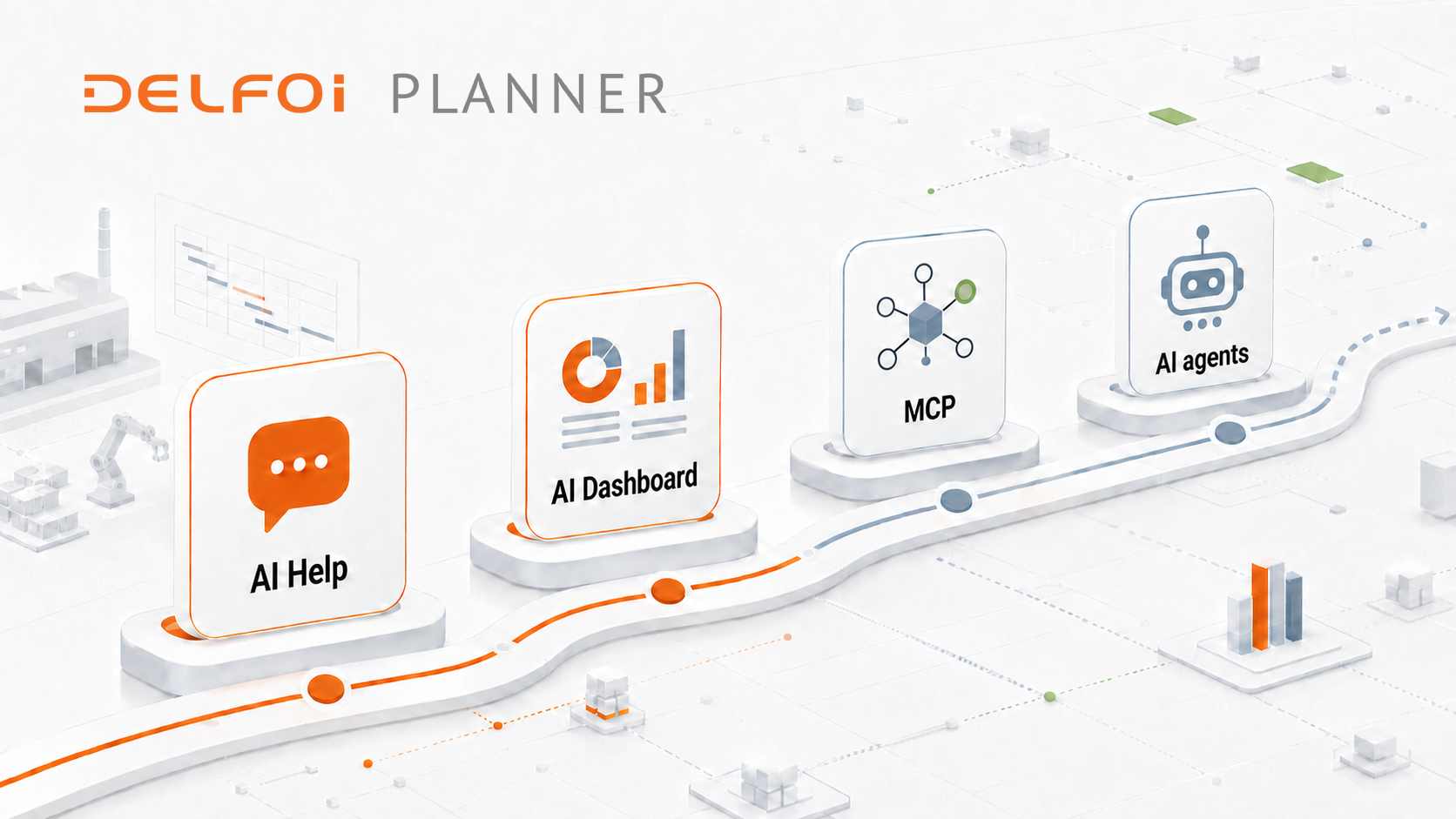
The discussion around manufacturing technology increasingly focuses on advanced analytics and artificial intelligence. These technologies offer significant opportunities, but they depend on reliable data and connected planning processes.
Efficient, AI-driven intelligent planning creates real value when it is built on up-to-date and accurate data. With the right foundation, we can help manufacturers generate better scenarios, support faster decisions, and make planning outcomes more visible, understandable, traceable, and reliable. In my view, this combination of connected data, intelligent planning, and practical transparency is becoming one of the most important competitive advantages a manufacturer can build today.
What is spreadsheet-based planning costing your business?
Spreadsheet-based planning may appear inexpensive because the software is already available. The more useful question is what the way of working around it is already costing the business. The real cost is often hidden in manual updates, weak visibility, delayed deliveries, excess inventory, overtime, and expediting.
Intelligent AI augmented APS solutions such as Delfoi Planner help manufacturers connect planning with business systems and production execution, enabling more reliable decisions, stronger delivery performance and better resilience.
Manufacturers that want to understand their own improvement potential can use the free Delfoi Planner Planning Value Check to estimate annual savings opportunities, expected delivery improvements, and potential payback, which, in our experience, can be achieved in just a few months. The assessment requires only a few high-level estimates and takes approximately five minutes to complete.