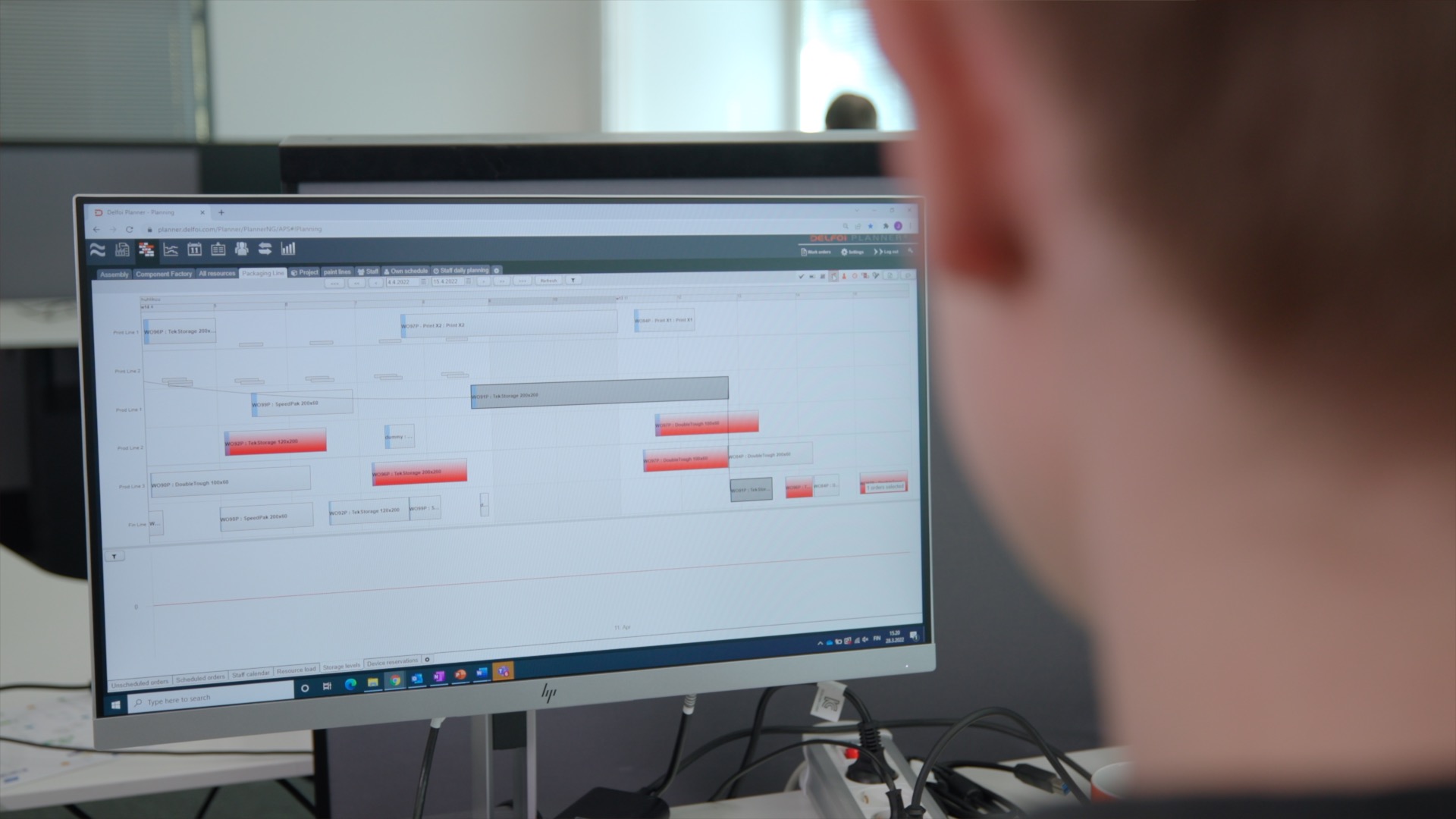
Finite capacity scheduling is a production planning method that respects real-world constraints, such as machine availability, operator hours, and tooling, when generating a schedule. Sometimes called finite production scheduling, it only assigns work to a resource when that resource actually has the capacity to take it on. Unlike MRP, which assumes unlimited resources are always available, finite capacity scheduling produces a plan that reflects what your shop floor can realistically achieve, not just what looks tidy on paper. The sections below unpack how each approach works, where they differ, and when it makes sense to use one, the other, or both.
Where does finite capacity scheduling fit in production planning?
Production planning operates across several time horizons, and understanding where finite capacity scheduling sits within that structure helps clarify what it actually does and why it matters. At the longest range, sales and operations planning (S&OP) sets aggregate targets for output, capacity, and inventory without worrying about individual machines or operators. In the medium range, master production scheduling (MPS) and MRP translate those targets into material requirements and component orders, still working largely with infinite capacity assumptions. At the shortest range, detailed scheduling takes over: this is where individual operations are sequenced across specific machines, workstations, and operators, with real constraints enforced.
Finite capacity planning operates at that detailed, short-horizon level. It takes the output of MRP and turns it into a sequence of operations that can actually be executed on the shop floor today, tomorrow, and across the coming weeks. MRP tells you what materials you need and when; finite scheduling tells you exactly when each operation can run, given everything else already competing for the same resources.
Recognizing this distinction matters because it changes how you think about the two tools. They are not alternatives to each other. They solve different problems at different levels of the planning hierarchy, and they work best when they work together.
How does finite capacity scheduling actually work?
Finite capacity scheduling works by loading production orders onto specific resources, such as machines, workstations, or operators, only up to the point those resources are actually available. Before assigning a task, the system checks whether the required resource has open capacity in the relevant time window. If not, the task is pushed forward until capacity exists, producing a schedule grounded in operational reality.
In practice, this means the scheduling engine maintains a live model of your production environment: shift patterns, planned downtime, tooling constraints, material availability, and workforce skills. When a new order arrives or priorities change, the system recalculates assignments across all constrained resources simultaneously, rather than treating each order in isolation.
The output is a sequence of operations that can actually be executed on the shop floor. Promised delivery dates are based on what the real production environment can deliver, not on theoretical lead times. This is a fundamental shift from traditional planning logic, where dates are calculated backwards from a due date with no check on whether the necessary resources are free.
What are the main limitations of MRP in production scheduling?
The core limitation of MRP in production scheduling is that it plans with infinite capacity. MRP backward-schedules from a due date and calculates what materials and components are needed, but it never checks whether the machines, operators, or workstations required are actually available at that moment. The schedule looks coherent on paper but frequently collapses the moment it meets the shop floor. The mrp vs finite scheduling distinction comes down to exactly this: one checks capacity, the other does not.
This creates a predictable chain of problems. When MRP releases orders that compete for the same bottleneck resource, planners are left manually firefighting priorities. Lead times are padded with safety buffers to absorb the chaos, which inflates work-in-progress and ties up capital. Delivery date reliability suffers because the original plan was never feasible to begin with.
MRP was designed primarily as a material requirements tool, and it performs that function well. It calculates dependent demand, drives purchase orders, and ensures components arrive on time. Where it struggles is in translating that material logic into an executable, time-phased sequence of operations that respects capacity constraints. That gap is exactly where finite capacity scheduling adds value.
What’s the difference between finite and infinite capacity scheduling?
The key difference between finite and infinite capacity scheduling is whether the planning system enforces resource limits. Infinite capacity scheduling assumes every resource is always available in whatever quantity is needed, generating plans that are mathematically neat but operationally unrealistic. Finite capacity scheduling enforces actual resource limits, producing a plan that reflects what can genuinely be done.
Infinite capacity scheduling
Infinite capacity scheduling is the default logic in most ERP and MRP systems. It calculates when work should happen based on lead times and due dates, without ever asking whether the required machine or person is free. The approach is fast and simple, which is why it became standard in enterprise systems, but it routinely produces plans that overload bottleneck resources and underload others.
Finite capacity scheduling
Finite capacity scheduling maintains a real-time model of resource availability and sequences operations accordingly. When a resource is fully booked, the system finds the next available slot rather than double-booking it. This constraint-aware logic produces longer planning cycles and requires more detailed master data, but the resulting schedule is achievable. Planners spend less time manually adjusting outputs and more time making genuine decisions about priorities.
A practical example: five orders, one bottleneck machine
Consider a CNC lathe with one eight-hour shift available. Five orders arrive, each requiring between two and four hours of machine time: in total, they add up to 14 hours of work. Under infinite capacity scheduling, the system assigns all five orders to that shift and promises all five due dates. Everything looks fine in the system. On the shop floor, however, six hours of work simply cannot happen, and the planner only finds out when the shift ends and three orders are still sitting in the queue.
Under finite capacity scheduling, the system recognizes immediately that only the first three or four orders fit within the available eight hours. The remaining orders are queued to the next available slot, and the system generates accurate commit dates for all five from the start. The planner can see the conflict before it becomes a missed delivery, communicate realistic dates to customers, and decide whether to expedite, split, or reschedule based on actual priorities. Finite scheduling surfaces the problem early; infinite scheduling hides it until the shop floor collapses.
When should a manufacturer use finite capacity scheduling instead of MRP?
A manufacturer should consider finite capacity planning when resource constraints are a regular source of schedule disruption. If your production environment has clear bottlenecks, high product mix variability, short lead times, or frequent order changes, infinite capacity planning will consistently produce schedules that cannot be executed as planned. Finite scheduling addresses these conditions directly.
Specific signals that finite capacity scheduling is the right move include:
- Planners spend significant time manually adjusting MRP outputs before releasing orders
- On-time delivery performance is inconsistent despite apparently solid plans
- The same machines or operators are repeatedly overloaded while others sit idle
- Customer lead time expectations have shortened and there is little room for buffer
- Production involves complex routings where multiple constrained resources interact
Manufacturers with simpler, high-volume, low-mix environments where capacity is rarely the binding constraint may find that MRP with manual capacity checks is sufficient. But for most discrete manufacturers operating in 2026, where responsiveness and delivery reliability are competitive differentiators, finite capacity scheduling for production planning provides a meaningful operational advantage.
What are the most common mistakes when implementing finite capacity scheduling?
Finite capacity scheduling delivers real benefits, but only when it is implemented with a clear understanding of where things typically go wrong. Several failure patterns appear repeatedly across manufacturing environments, and recognizing them early saves a lot of pain.
The first and most common mistake is treating an infinite-capacity MRP plan as a binding delivery commitment. When customer-facing dates are confirmed directly from MRP output, without any capacity check, the shop floor inherits a plan it cannot execute. Finite scheduling needs to be in the loop before commitments are made, not after.
A second failure mode is constraining the wrong resources. Finite scheduling is most valuable when it is applied to the true bottleneck, the resource that actually limits throughput. Constraining only secondary resources while leaving the real bottleneck unchecked produces a schedule that looks finite but behaves like an infinite plan in practice. Identifying the genuine constraint first is a prerequisite, not an afterthought.
Third, running finite scheduling on stale or inaccurate master data undermines the entire exercise. A schedule is only as reliable as the capacity data it is built on. If a machine’s routing assumes 100% utilization but its real overall equipment effectiveness (OEE) is 60%, the finite schedule is nominally constrained but practically as unrealistic as an infinite plan. Cycle times, setup matrices, and routing sequences need to reflect shop floor reality, not the assumptions that were entered into the system years ago.
Finally, applying detailed finite scheduling logic too far into the future creates unnecessary complexity. In the long planning horizon, rough-cut capacity checks are usually sufficient. Detailed finite scheduling adds the most value in the short-range execution window, where specific machines, operators, and orders are actually being committed. Pushing that level of detail out weeks or months ahead is computationally expensive and rarely actionable.
Can finite capacity scheduling and MRP work together?
Yes, finite capacity scheduling and MRP work very well together, and in most manufacturing environments they are designed to complement each other rather than compete. MRP handles the material planning layer, calculating what components and raw materials are needed and when. Finite capacity scheduling then takes those requirements and sequences them into an executable plan that respects real resource constraints.
In this combined model, MRP continues to do what it does best: driving procurement, managing inventory levels, and calculating dependent demand across a bill of materials. The finite scheduling layer sits on top of the ERP and translates MRP’s output into a shop floor sequence that accounts for machine availability, operator shifts, tooling, and competing orders. Real time finite scheduling means that when something changes on the shop floor, whether a machine goes down, an urgent order arrives, or a supplier delivers late, the schedule can be recalculated immediately against live constraints rather than waiting for the next MRP run. Achievable dates are then written back into the ERP, keeping the material plan aligned with what production can actually deliver.
This is the approach we take at Delfoi: layering constraint-based finite scheduling on top of the existing ERP environment rather than replacing it. The ERP remains the system of record for materials and master data, while the scheduling layer ensures that the production plan reflects operational reality. The two systems reinforce each other, and planners get a single, coherent picture of what is possible rather than two conflicting views of the same operation. Contact us to discuss your scheduling needs.