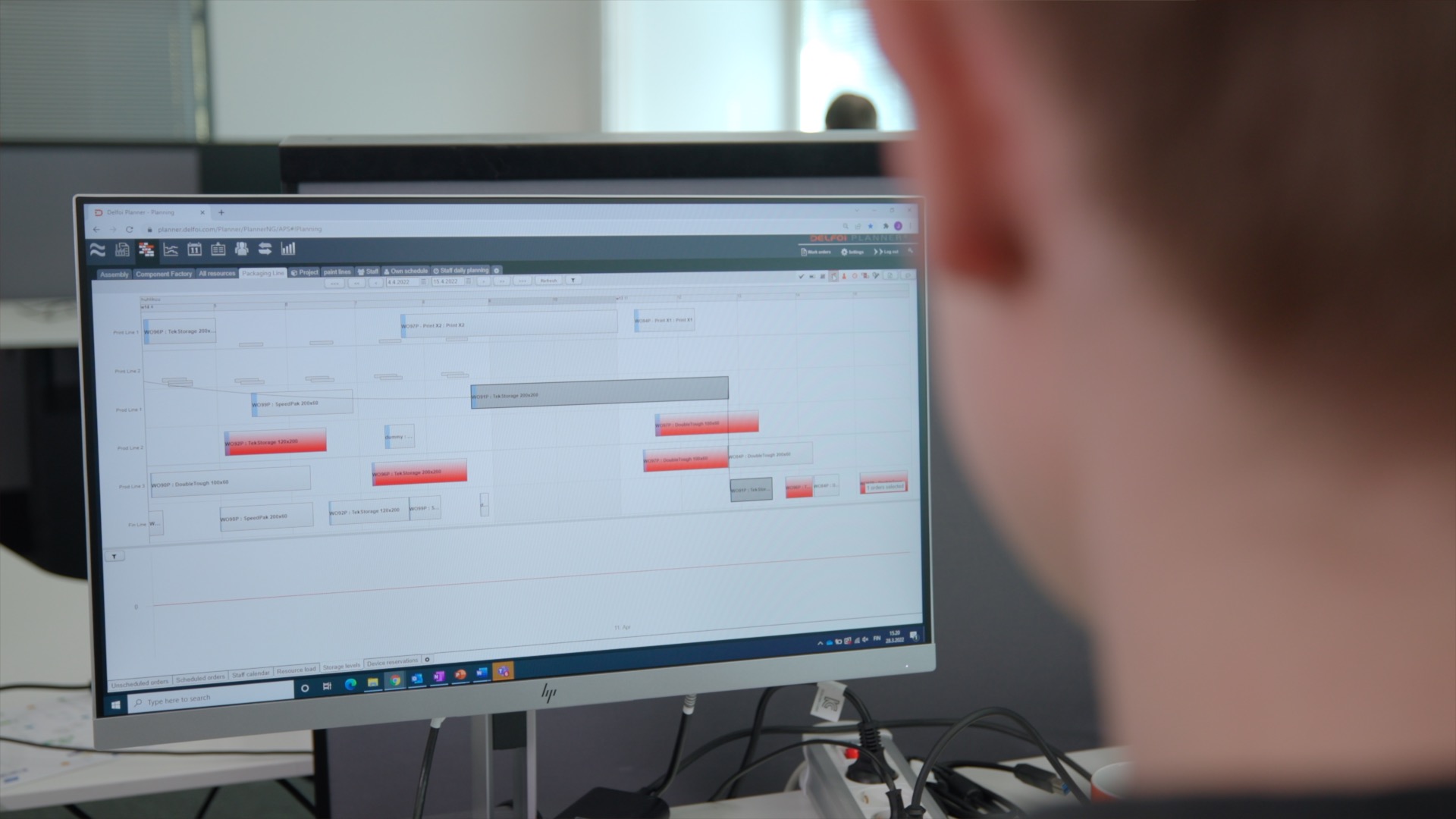
Finite capacity planning schedules production around real-world constraints, such as machine availability, staff shifts, and material supply, so that every job is assigned only when the resources to complete it actually exist. Infinite capacity planning, by contrast, calculates when work should be done without checking whether the required resources are free. The core difference is whether the plan respects physical limits or ignores them. The sections below unpack how each method works, where each fits, and how manufacturers can use them together effectively.
How does finite capacity planning actually work?
Finite capacity planning works by scheduling each production order against a real-time picture of available resources, including machines, operators, tooling, and materials, so that no two jobs are assigned to the same resource at the same time. The system sequences work based on actual availability, shifting tasks forward or backward in time until a feasible slot is found. The result is a schedule that can survive contact with reality.
In practice, a finite scheduler holds a live model of the shop floor. When a new order arrives, the system checks every constraint in the chain before committing to a start date. If a machine is already booked, the job waits or is routed to an alternative resource. If a component is delayed, every downstream operation moves accordingly. This constraint-aware logic is what separates finite scheduling from a simple spreadsheet or a standard ERP plan.
Most ERP and MRP systems plan with infinite capacity by default. They backward-schedule from a due date and never verify whether the machine or operator is actually free, so the plan looks clean on paper but collapses the moment a real constraint appears. Layering finite, constraint-based scheduling on top of an ERP fixes this by writing achievable dates back into the system based on what the shop floor can genuinely deliver.
What is infinite capacity planning used for?
Infinite capacity planning is used for high-level demand planning, sales forecasting, and rough-cut capacity analysis, where the goal is to understand whether a production volume is broadly achievable over a longer horizon rather than to produce an executable daily schedule. It answers questions like “Can we take on this order?” before committing to a customer, without the computational overhead of a full constraint check.
Infinite planning is a useful starting point in the planning hierarchy. When a business needs to model several demand scenarios quickly, or when a sales team needs a fast lead-time estimate, infinite capacity gives a directional answer quickly. It is also commonly used in master production scheduling at a weekly or monthly level, where small daily imbalances are assumed to average out over time.
The important caveat is that infinite capacity planning is a planning tool, not a scheduling tool. The moment a plan needs to translate into actual shop-floor instructions, resource constraints must enter the picture. Using infinite planning alone to drive execution is where manufacturers run into missed due dates and overloaded work centers.
What are the key differences between finite and infinite capacity planning?
The key difference between finite and infinite capacity planning is that finite planning enforces resource constraints when building the schedule, while infinite planning ignores them. Finite planning produces an executable sequence of work orders; infinite planning produces a theoretical load picture that still needs to be validated against real capacity before it can be acted on.
The differences play out across several practical dimensions:
- Resource visibility: Finite planning requires a detailed model of machines, people, and materials. Infinite planning works with aggregate capacity figures or none at all.
- Schedule accuracy: Finite schedules are achievable by design. Infinite schedules are optimistic by design and require manual adjustment.
- Planning horizon: Infinite planning suits week-to-month horizons. Finite planning is most valuable at the day-to-week execution level.
- Computational complexity: Finite scheduling is more demanding to set up and run, because it must solve a real constraint-satisfaction problem. Infinite planning is faster and simpler.
- Response to disruption: A finite scheduler can resequence automatically when a machine breaks down or a job is expedited. An infinite plan has no mechanism to absorb disruption.
When should a manufacturer choose finite over infinite scheduling?
A manufacturer should choose finite capacity scheduling when production runs close to capacity, when due-date reliability is commercially critical, or when the shop floor has bottleneck resources that regularly constrain output. In these conditions, an infinite plan will consistently overcommit the business and erode customer trust.
Finite scheduling becomes especially important in environments with high product mix, short lead times, or frequent order changes. When dozens of different jobs compete for the same machine in the same week, only a constraint-aware scheduler can produce a sequence that actually works. Trying to manage this with an infinite plan means a planner spends most of their day manually firefighting the gap between what the system promised and what the floor can deliver.
High-volume, repetitive manufacturing with stable, predictable demand and ample spare capacity is the scenario where infinite planning can hold up on its own for longer. But as variability increases and margins tighten, the case for finite scheduling for production planning strengthens considerably.
What are the limitations of infinite capacity planning?
The main limitation of infinite capacity planning is that it produces schedules that cannot be executed as-is. Because the method does not account for resource availability, it routinely overloads work centers, generates unrealistic lead times, and creates due-date commitments the shop floor cannot meet. The plan looks complete, but it is not actionable without significant manual intervention.
Other practical limitations include:
- Hidden bottlenecks: Infinite planning cannot identify which resources are genuinely constraining throughput, because it never models resource utilization at a granular level.
- Poor change response: When a machine breaks down or a priority order arrives, an infinite plan offers no automatic way to resequence. Every change requires a planner to rebuild the schedule manually.
- False confidence: A neatly printed infinite schedule can create the impression that production is under control when it is not, delaying the recognition of a capacity problem until it becomes a crisis.
- Cumulative error: In complex multi-stage production, small inaccuracies at each stage compound into large delivery errors by the time a job reaches final assembly.
These limitations do not make infinite planning worthless. They do mean that any manufacturer using infinite planning for execution-level scheduling is accepting a structural gap between plan and reality.
Can finite and infinite capacity planning be used together?
Yes, finite and infinite capacity planning are most effective when used together at different levels of the planning hierarchy. Infinite planning handles the longer-horizon demand and sales picture, while finite scheduling takes over at the execution level to turn that demand signal into an achievable, sequenced production plan.
This layered approach is how modern production planning environments typically operate. An MRP or ERP system runs infinite planning to generate a rough production requirement across weeks or months. A finite scheduling layer then takes that requirement and resolves it against real shop-floor constraints, producing a daily or weekly schedule that planners and operators can actually follow.
The handoff between the two layers is where most planning problems occur. If the finite scheduler is not tightly integrated with the demand signal coming from the infinite plan, the two systems drift apart and planners are left reconciling conflicting information. The goal is a seamless flow from demand forecast through to sequenced shop-floor instructions, with each layer doing the job it is genuinely suited for. Getting that integration right is, in our experience, one of the highest-value improvements a manufacturing business can make to its planning process. Contact us to discuss your planning needs and find out how we can help.