Real-time production rescheduling is the process of automatically or semi-automatically updating a production plan the moment an unexpected event occurs, rather than waiting for the next scheduled planning cycle. Instead of running on fixed weekly or daily intervals, the schedule adjusts continuously as new information arrives. This article unpacks how it works, what drives it, and when it makes sense to invest in the capability.
How does real-time production rescheduling differ from traditional scheduling?
Traditional scheduling produces a static plan at a fixed point in time, typically weekly or daily, and that plan governs production until the next review. Real-time production rescheduling replaces that fixed cycle with a continuous process: the moment reality deviates from the plan, the schedule updates and the downstream effects propagate automatically across all affected orders.
In a traditional setup, the gap between when a disruption happens and when the plan reflects it can be hours or even days. During that gap, planners work from an outdated picture. They spend their time firefighting rather than planning, manually rearranging jobs and making judgment calls without a clear view of the knock-on consequences. The plan becomes a rough guide at best.
Dynamic production planning closes that gap. The schedule is always a current reflection of shop floor reality, which means planners can spend their time on genuine decision-making rather than reactive patching. The difference is not just speed; it is a fundamentally different relationship between the plan and the operation.
What triggers a real-time production reschedule?
A real-time reschedule is triggered by any event that makes the current plan inaccurate or unexecutable. Common triggers include machine breakdowns, material shortages or late deliveries, operator absences, quality failures that require rework, rush orders from customers, and changes in order priority from sales or management.
Not every event carries the same weight. A minor delay on a low-priority job may not require a full reschedule, while a breakdown on a bottleneck machine can invalidate the plan for dozens of downstream orders. Effective real-time scheduling systems distinguish between events that require immediate replanning and those that can be absorbed within existing buffers.
The key point is that the trigger is the event itself, not a planner noticing the event and deciding to act. In a well-designed system, the connection between shop floor reality and the planning layer is direct and fast enough that the schedule responds before the disruption has time to cascade.
How does real-time rescheduling actually work step by step?
Real-time rescheduling follows a closed loop: detect, evaluate, replan, and communicate. Each cycle can complete in seconds or minutes rather than hours, and the loop runs continuously throughout the production day.
- Detect: The system receives a signal that the current plan is no longer valid. This signal can come from a machine sensor, an ERP event, a manual input from a supervisor, or an automated alert from a connected system.
- Evaluate: The planning engine assesses the impact of the disruption. Which orders are affected? What is the new feasible sequence given current resource availability, material status, and order priorities?
- Replan: The system generates an updated schedule. This is where the logic of the scheduling engine for production planning matters most: it must respect constraints such as machine capacity, tooling availability, operator skills, and customer due dates while minimizing the overall impact of the disruption.
- Communicate: The updated plan is pushed to the relevant stakeholders, whether that is a shop floor display, a supervisor’s dashboard, or a customer-facing delivery estimate. Everyone works from the same current picture.
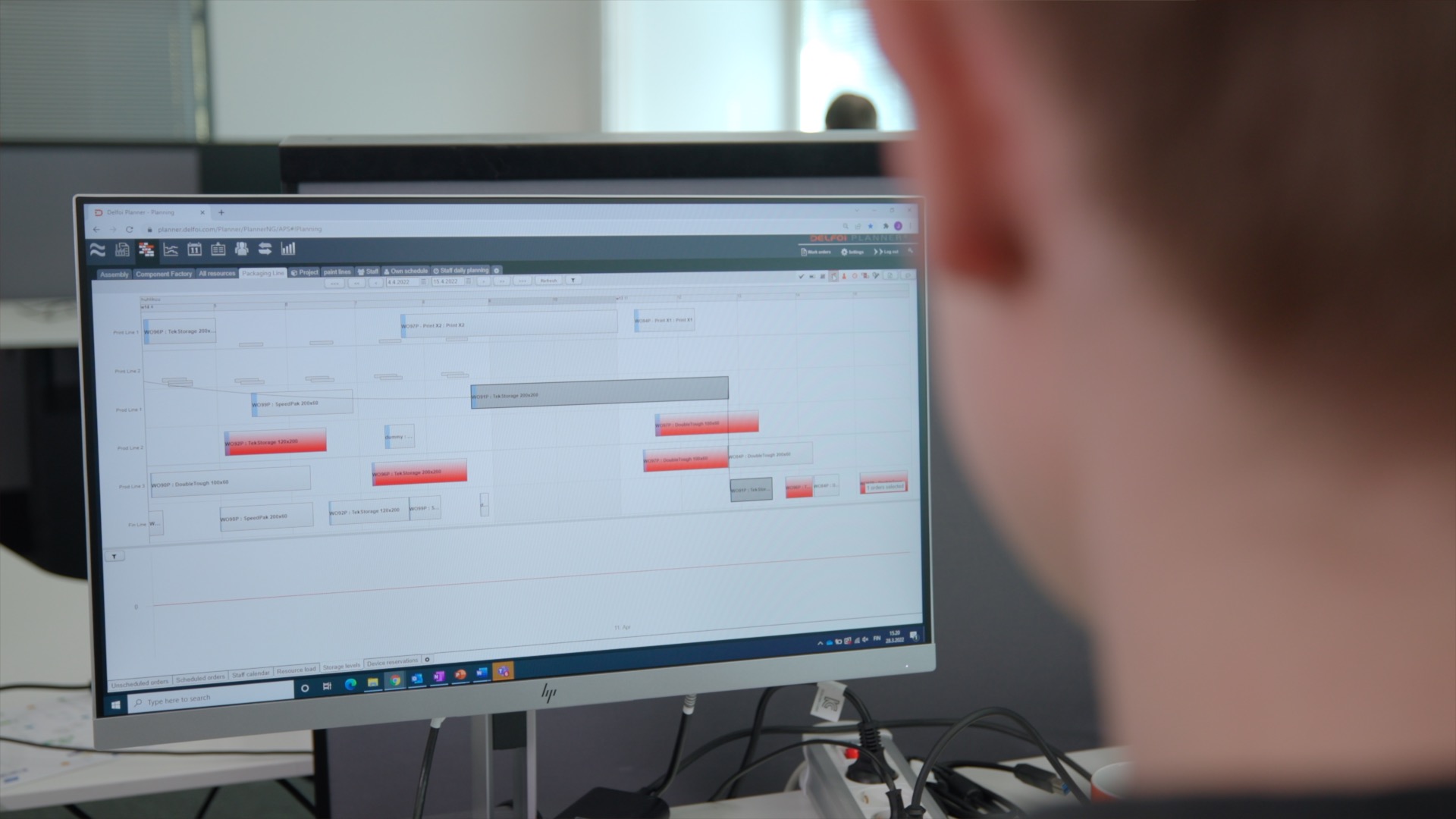
The ripple effect is a critical concept here. Rescheduling one job does not happen in isolation; it shifts the start and end times of every subsequent job that shares the same resources. A good real-time scheduling system makes that ripple visible immediately, so planners can reprioritize without inadvertently breaking something further downstream.
What data does real-time rescheduling rely on?
Real-time manufacturing scheduling depends on accurate, timely data from multiple sources. The core data categories are machine and resource availability, material and inventory status, order priorities and due dates, and actual production progress against the plan.
Machine availability data typically comes from sensors, MES systems, or operator inputs that report status changes such as breakdowns, setups, and maintenance windows. Material status comes from warehouse management or ERP systems. Order priorities are usually maintained in the ERP and updated by sales or planning teams when customer requirements change.
Production progress, meaning how far each job has actually advanced versus where the plan assumed it would be, is perhaps the most important data stream. Without accurate progress reporting, the system cannot know whether the current plan is still valid. This is why real-time scheduling capability and shop floor data collection are so closely linked in practice.
The quality of the reschedule output is directly proportional to the quality and freshness of the input data. Organizations that invest in real-time scheduling without first establishing reliable data feeds often find that the system produces plans that look precise on screen but do not match reality on the floor.
What are the main benefits of real-time production rescheduling?
The primary benefits of real-time production rescheduling are reduced firefighting for planners, better on-time delivery performance, improved resource utilization, and greater operational transparency across the organization.
When planners no longer need to manually reconstruct the schedule after every disruption, they reclaim time for higher-value work: capacity analysis, supplier coordination, and medium-term planning. The shift from reactive to proactive planning is one of the most consistent improvements organizations report after adopting real-time scheduling tools.
On-time delivery improves because the plan always reflects current reality. When a disruption occurs, the system immediately identifies which customer orders are at risk, giving planners the information they need to communicate proactively rather than discovering problems after a deadline has been missed.
Resource utilization benefits because the schedule is always optimized against actual availability rather than assumed availability. Idle time caused by waiting for materials or instructions decreases, and bottleneck resources are used more effectively because the system can continuously resequence work to keep them loaded.
When should a manufacturer invest in real-time rescheduling capabilities?
A manufacturer should invest in real-time rescheduling when disruptions are frequent enough that the gap between the plan and reality is a daily operational problem rather than an occasional exception. If planners are spending more time adjusting the schedule than using it to guide decisions, that is a clear signal.
Other indicators include high variability in demand or lead times, a complex mix of products sharing constrained resources, and customer expectations for short and reliable delivery windows. Manufacturers operating in engineer-to-order or mixed-mode environments tend to benefit most, because the number of interdependencies makes manual replanning genuinely difficult to do well at speed.
It is worth being honest about the prerequisites. Real-time scheduling capability delivers its full value only when the underlying data infrastructure is in place. Organizations that are still relying on spreadsheets for production tracking or that lack reliable machine status data will need to address those gaps alongside or before investing in advanced scheduling software.
For manufacturers that do meet those conditions, the investment case is straightforward. The combination of reduced planning overhead, better delivery reliability, and improved resource efficiency typically delivers measurable returns within the first year of operation. We work with manufacturing organizations at exactly this point of readiness, helping them move from reactive planning to a genuinely dynamic production planning process that holds up under real operational pressure. Contact us to discuss your planning needs.