Production planning helps manufacturers keep customer commitments by translating real resource availability into realistic delivery dates before a promise is ever made. When scheduling is built on actual capacity rather than theoretical throughput, quoted lead times hold up under real-world conditions. The sections below unpack the specific challenges, mechanisms, and tools that determine whether a manufacturer can be trusted to deliver on time in 2026.
What happens when manufacturers miss customer delivery commitments?
When manufacturers miss delivery commitments, the immediate consequence is a damaged customer relationship, but the downstream effects go much further. Late deliveries trigger penalty clauses, emergency freight costs, and expedited production runs that disrupt the entire shop floor schedule. Over time, repeated misses erode the trust that takes years to build and open the door for competitors to step in.
From an operational standpoint, a missed commitment rarely stays contained. One delayed order forces planners to re-sequence the entire production queue, which in turn pushes back other customers’ orders. The ripple effect compounds quickly, and teams spend more time firefighting than planning. Customer service teams absorb the pressure, and sales teams find themselves defending relationships instead of growing them.
The financial cost is real too. Expediting materials, paying overtime, and absorbing freight premiums all erode margins on orders that were already priced competitively. For manufacturers operating on tight margins, a pattern of missed commitments can be the difference between a profitable quarter and a difficult one.
How does production planning determine delivery reliability?
Production planning determines delivery reliability by establishing whether the required capacity, materials, and sequencing actually exist at the time a delivery date is promised. A plan that accounts for confirmed resource availability converts a hoped-for date into a credible commitment. Without that grounding, quoted lead times are little more than optimistic estimates.
The connection between planning and reliability works through several mechanisms. First, a good plan identifies bottlenecks before an order enters the queue, not after. Second, it sequences work in a way that keeps machines and people loaded efficiently without creating artificial delays. Third, it flags material shortages early enough to resolve them before they affect the production floor.
Reliable delivery performance is therefore not primarily a logistics problem or a customer service problem. It is a production planning problem. Manufacturers who invest in structured, data-driven planning processes consistently outperform those who rely on experience and intuition alone, particularly as order volumes and product complexity grow.
What are the biggest production planning challenges manufacturers face in 2026?
The biggest production planning challenges manufacturers face in 2026 center on demand volatility, workforce variability, and the growing complexity of product portfolios. Supply chains have not fully stabilized after years of disruption, and customers now expect shorter lead times alongside greater flexibility, which puts intense pressure on planning teams to respond faster with less margin for error.
Several specific challenges stand out across the manufacturing sector this year:
- Demand unpredictability: Fluctuating order volumes make it difficult to maintain stable production schedules without either carrying excess capacity or turning customers away.
- Data fragmentation: Many manufacturers still rely on ERP systems, spreadsheets, and tribal knowledge in parallel, making it hard to get a single accurate picture of capacity and load.
- Skilled labor constraints: Workforce availability directly affects capacity, and many manufacturers struggle to factor in absences, training, and turnover in real time.
- Increasing product variety: Custom and configure-to-order products require more granular planning than standardized production runs, which older planning tools often cannot handle well.
- Change management: When a priority order arrives or a machine goes down, replanning the entire schedule quickly and communicating changes to the shop floor remains a significant operational challenge.
Manufacturers who address these challenges through structured manufacturing planning processes for production scheduling gain a measurable competitive advantage, particularly in industries where on-time delivery is a key differentiator.
How can real-time production data improve customer promise accuracy?
Real-time production data improves customer promise accuracy by giving planners a live view of what is actually happening on the shop floor, rather than what was expected to happen. When actual progress, machine status, and queue lengths are visible in real time, the gap between planned and actual capacity narrows, and delivery dates can be quoted with genuine confidence.
Without real-time visibility, planners work from yesterday’s snapshot. A machine that broke down this morning, a batch that took longer than estimated, or a material delivery that arrived late all affect available capacity, but none of those changes are reflected in a static plan. Promises made before those events are discovered are already unreliable.
With live data feeding the planning system, several things become possible. Planners can see immediately how a disruption affects the schedule and replan around it. Sales teams can give customers accurate, updated timelines rather than guessing. And management can monitor on-time delivery performance as it develops, not after the fact. Operational transparency of this kind is one of the clearest paths from reactive firefighting to proactive delivery management.
What’s the difference between finite and infinite capacity planning for delivery commitments?
Finite capacity planning schedules work based on the actual resources available, meaning it will not schedule more work than a machine or team can physically handle in a given time window. Infinite capacity planning ignores resource limits and assumes work can always be completed on time regardless of load. For delivery commitments, this distinction is fundamental.
Infinite capacity planning is common in basic ERP systems. It can generate a schedule quickly, but the dates it produces are theoretical. When actual capacity is exceeded, orders slip, and the quoted dates become unreliable. Planners often know the dates are optimistic but have no systematic way to correct them before a commitment is made to a customer.
Finite capacity planning builds the schedule around what is actually possible. If a work center is fully loaded for the next two weeks, new orders are scheduled after that load clears, or the system identifies which existing order could be moved to create room. The delivery date that results from this process is one the manufacturer can genuinely stand behind.
This is the core principle behind how we approach scheduling at Delfoi. Delivery dates are derived from the capacity you actually have, which means the quotes you give customers hold up when production begins. For manufacturers where missed commitments carry real commercial consequences, the shift from infinite to finite scheduling is one of the most impactful planning improvements available.
Which production planning tools help manufacturers keep commitments at scale?
Production planning tools that help manufacturers keep commitments at scale are those that combine finite capacity scheduling, real-time shop floor visibility, and fast replanning capability in a single integrated environment. The ability to see current load, simulate the impact of new orders, and communicate schedule changes quickly is what separates tools that support reliable delivery from those that simply document plans.
When evaluating planning tools for delivery reliability, the following capabilities matter most:
- Finite scheduling engine: The tool must schedule against real capacity, not theoretical throughput, so that every delivery date it generates is achievable.
- Real-time data integration: Connection to shop floor systems, ERP, and material status ensures the plan reflects current reality, not a snapshot from yesterday.
- Scenario planning: The ability to model the effect of a rush order or a machine breakdown before committing to a new schedule protects existing customer promises.
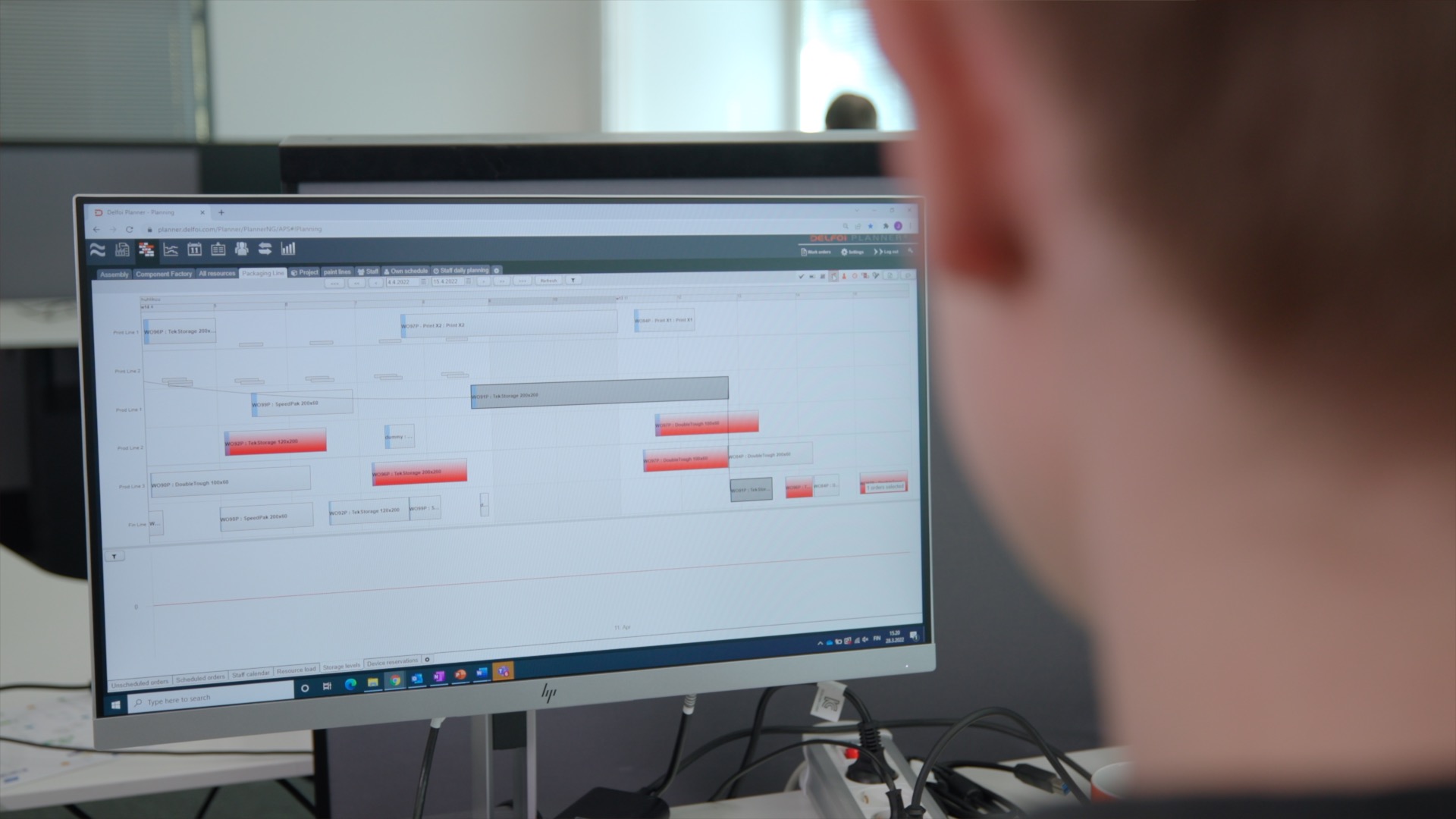
- Visual production boards: Planners and shop floor supervisors need to see the same picture. Visual tools reduce miscommunication and speed up response to disruptions.
- Change management support: When priorities shift, the tool should make it straightforward to replan, communicate changes, and track the impact on all affected orders.
Advanced production scheduling solutions designed specifically for manufacturing environments address all of these needs. For manufacturers moving beyond spreadsheets or basic ERP scheduling, purpose-built tools provide the structure and speed needed to make reliable delivery commitments part of everyday operations rather than a best-case outcome. Contact our team to discuss your planning needs and find out how finite scheduling can work for your operations.