Integrating ERP systems into production planning and control enables manufacturers to gain real-time insights, streamline communication, and enhance decision-making. By unifying disparate production data into a centralized platform, ERP integration provides immediate visibility into operations, resources, and bottlenecks. This comprehensive transparency allows manufacturers to quickly identify inefficiencies, respond proactively to demand fluctuations, and optimize the manufacturing process, ultimately driving productivity, reducing costs, and improving overall operational efficiency.
What is ERP integration in manufacturing?
ERP integration in manufacturing involves connecting the functional systems and data streams that govern production into a single, unified software environment. In practice, this means linking modules such as production scheduling, inventory and materials management, procurement, quality control, human resources planning, and financial reporting so that they operate from a shared data layer rather than in isolation. A confirmed purchase order, for example, is immediately reflected in material availability within the scheduling module, without manual re-entry or batch synchronization delays. This real-time data synchronization across integrated modules is what gives ERP integration its operational value.
The shared data architecture means that a change in one part of the system propagates instantly to every other relevant module. Planners see updated stock levels the moment a goods receipt is posted. Finance sees actual production costs as work orders are completed. Quality teams receive batch records as production runs close. This is the core mechanism behind improving operational visibility through ERP integration: master data is maintained once and consumed everywhere.
For IT leaders evaluating the current state of their organization, the contrast with fragmented alternatives is instructive. Many manufacturers still coordinate production across a combination of standalone MES systems, spreadsheet-based scheduling tools, and disconnected ERP modules that require manual reconciliation. ERP integration for manufacturing replaces that patchwork with a coherent, interoperable architecture that scales as the business grows.
Why does ERP integration enhance production visibility?
Enhanced production visibility is one of the primary advantages of ERP integration. By centralizing critical production data, manufacturers gain immediate access to real-time production insights, allowing them to monitor operations continuously and react promptly to changing conditions. ERP integration streamlines communication between departments, reduces information silos, and empowers informed decision-making. Manufacturers can better plan resource allocation, track performance metrics, and readily adapt to market shifts or unexpected disruptions with minimal delay.
How can ERP integration reduce production bottlenecks?
ERP integration effectively identifies and mitigates bottlenecks by providing comprehensive visibility into the manufacturing process. The following are concrete examples of common production issues and ERP solutions:
- Material shortages: Real-time inventory tracking highlights supply deficits early, allowing planners to adjust procurement schedules proactively.
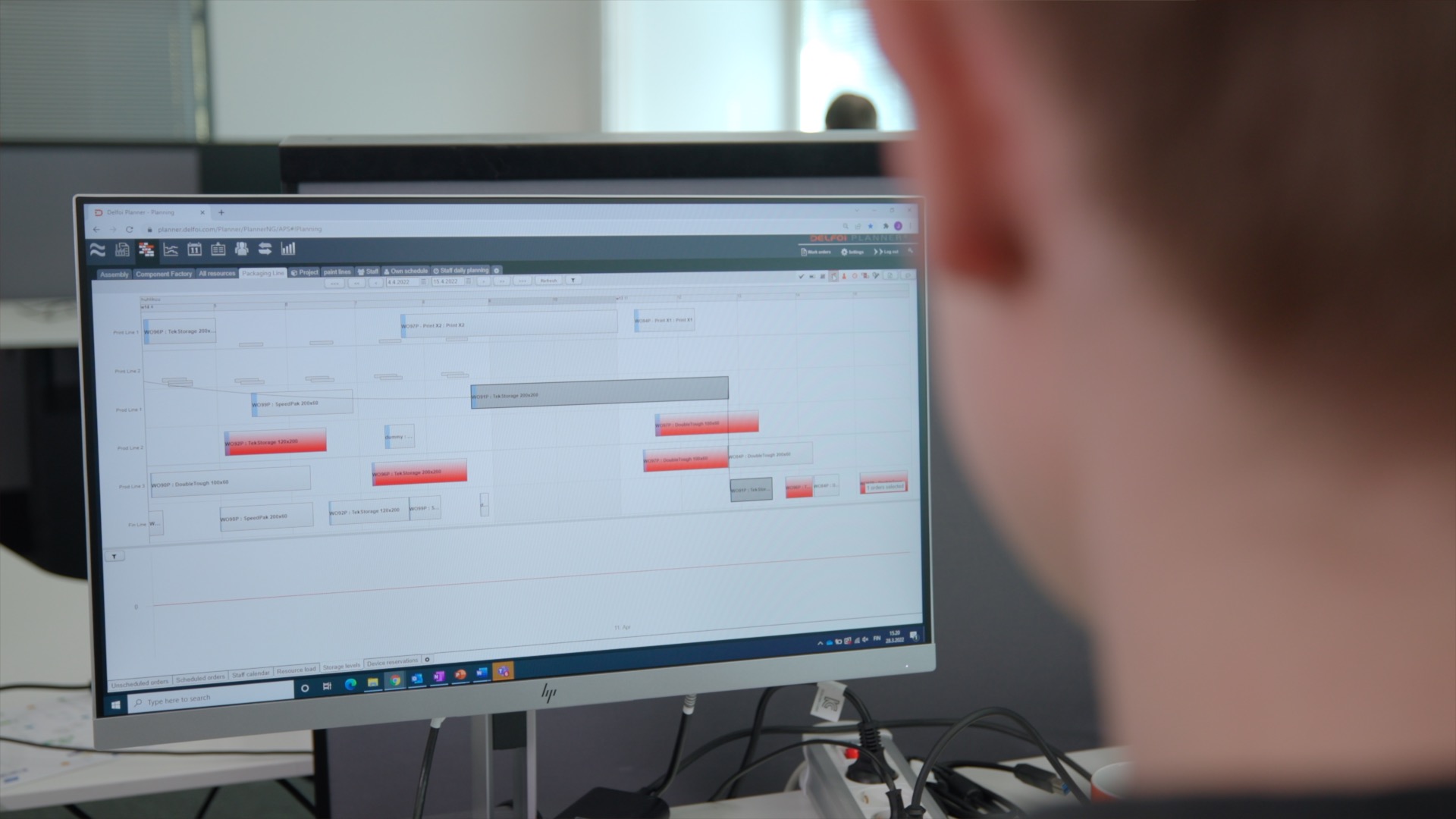
- Resource overload: Finite scheduling algorithms, such as those offered in Delfoi Planner, balance workloads across available resources, preventing over-allocation and downtime.
- Human resource constraints: HR planning modules identify skill gaps and availability issues, enabling managers to schedule shifts and allocate labor efficiently.
By addressing these common bottlenecks, ERP integration significantly improves productivity, reduces delays, and enhances delivery reliability.
How does ERP integration improve end-to-end supply chain visibility?
Improving operational visibility through ERP integration extends well beyond the production floor. When procurement, planning, and logistics teams operate from a single source of truth, the entire value chain becomes observable and manageable in real time. ERP integration for manufacturing connects these functions so that decisions made upstream are immediately visible downstream, reducing the information lag that causes costly misalignments.
Procurement and supplier performance monitoring
Integrated ERP data gives procurement teams a live view of supplier lead times, open purchase orders, and delivery reliability metrics. When a supplier confirms a delayed shipment, that information propagates immediately to the production scheduling module, allowing planners to reassign capacity or prioritize alternative work orders before the shortage becomes a line stoppage. Over time, this data accumulates into a supplier performance record that informs sourcing decisions and contract negotiations.
Real-time inventory and demand forecasting
One of the persistent challenges in manufacturing is the bullwhip effect, where small fluctuations in customer demand are amplified into large swings in inventory and procurement. Integrated ERP data reduces this effect by giving planners accurate, current demand signals rather than lagged reports. When sales orders update in real time, the scheduling module can adjust production quantities and material requirements before shortages or overstock situations develop, keeping inventory lean without sacrificing service levels.
Order fulfillment tracking from production floor to delivery
End-to-end order visibility means that a production manager, a logistics coordinator, and a customer service representative can all see the same order status without making phone calls or pulling separate reports. When a work order closes on the shop floor, the ERP system can automatically trigger the next step in the fulfillment chain, whether that is a quality inspection, a warehouse pick, or a shipping notification. This traceability connects production performance directly to delivery reliability, which is ultimately what customers measure.
How do different manufacturing types benefit from ERP integration?
ERP integration for manufacturing is not a single, uniform capability. Its value depends significantly on the production model the organization operates, and IT leaders should understand how integration requirements and benefits differ across manufacturing types before defining system architecture or selecting complementary planning tools.
Discrete manufacturing
Discrete manufacturers, including job shops, assembly lines, and make-to-order operations, deal with individual, countable units that move through defined work centers and routings. For these environments, ERP integration enables finite capacity scheduling, which matches work orders to available machine and labor capacity rather than assuming infinite throughput. Work order tracking becomes granular enough that planners can see exactly where a specific assembly is in the production sequence, and component traceability ensures that quality issues can be traced back to specific batches or suppliers. A practical example: when a customer requests an expedited delivery, an integrated system allows the planner to immediately assess capacity impact across all active work orders and make an informed commitment rather than an optimistic guess.
Process manufacturing
Process manufacturers, operating batch production, continuous flow, or formula-based production environments, have different integration priorities. Here, real-time production visibility in ERP centers on batch traceability, recipe and formula management, and real-time yield monitoring. Regulatory and quality compliance often requires lot-level records that link raw material inputs to finished goods outputs, and an integrated ERP environment makes that linkage automatic rather than manual. For example, when a batch yield falls below the expected threshold, an integrated system can flag the deviation immediately, triggering a quality review before the batch advances to the next stage.
Mixed-mode manufacturers
Many industrial manufacturers operate in a mixed-mode environment, combining elements of both discrete and process production depending on the product line. For these organizations, integration complexity is higher because the ERP and any complementary planning systems must handle different scheduling logics and data structures within the same architecture. Choosing solutions with flexible integration capabilities and proven interoperability across both production modes is a key technical requirement in this context.
When should a business consider integrating ERP into their production process?
A business should consider ERP integration into its manufacturing processes when encountering these key indicators:
- Frequent delays or missed delivery deadlines due to poor scheduling visibility
- Difficulty tracking real-time production status across different production lines or facilities
- High levels of work-in-progress (WIP) inventory or excessive lead times
- Reliance on manual or spreadsheet-based scheduling methods that cannot scale with business growth
- Persistent communication breakdowns between departments, resulting in operational inefficiencies
ERP integration helps resolve these issues, delivering immediate and sustainable improvements in production efficiency and market responsiveness.
What are the best practices for successful ERP integration in production?
To ensure successful ERP integration, manufacturers should adhere to the following best practices:
- Clearly defined goals: Identify specific visibility, efficiency, or productivity goals before implementation.
- Engage stakeholders early: Involve key users and stakeholders from all departments to ensure acceptance and effective utilization of the ERP system.
- Choose user-friendly solutions: Select intuitive, visual ERP solutions, such as Delfoi Planner, that facilitate user adoption and minimize resistance.
- Prioritize integration: Ensure smooth interoperability between the ERP solution and existing systems (e.g., SAP S/4HANA, Dynamics 365) to leverage existing IT investments and data resources.
- Ongoing training and support: Provide continuous training and support to users, allowing them to maximize ERP capabilities and respond effectively to changes.
By following these practices, businesses can significantly enhance visibility, streamline production, and avoid common ERP integration pitfalls.
What are the most common ERP integration challenges, and how can manufacturers avoid them?
A realistic assessment of ERP integration must include the failure modes that derail projects before they deliver value. For IT leaders responsible for implementation outcomes, understanding where integrations typically break down is as important as understanding the benefits. The following challenges appear consistently across manufacturing integration projects, along with practical approaches to mitigating each one.
Data quality and migration issues
Poor master data quality is one of the most common causes of ERP integration failure. When item masters, routings, bill of materials structures, or supplier records contain errors or inconsistencies, those errors propagate across every integrated module, compounding rather than resolving operational problems. A pre-integration data audit is a prerequisite, not an afterthought. Investing time in cleansing and standardizing master data before go-live significantly reduces the risk of post-launch disruptions.
Change management and user adoption resistance
Technical integration can succeed while the project still fails if end users do not adopt the new workflows. Resistance is most common when users feel the system was configured without their input or when they do not understand why existing processes are changing. Involving end users in configuration decisions early, and communicating clearly what the system change is intended to solve, reduces friction and accelerates adoption. Change management is not a soft concern; it directly affects whether the integration delivers its intended operational value.
Over-customization that increases complexity
The flexibility of modern ERP platforms can become a liability when organizations customize too heavily to replicate legacy workflows rather than adapting to the platform’s intended design. Excessive customization increases implementation time, raises maintenance costs, and complicates future upgrades. A more sustainable approach is to configure within the standard capabilities of the system and reserve custom development for genuinely unique business requirements that cannot be addressed any other way.
Underestimating integration complexity with legacy systems
Many manufacturing environments include legacy systems, older MES platforms, or proprietary machine interfaces that were not designed with modern API connectivity in mind. Connecting these systems to a contemporary ERP environment often requires middleware, custom adapters, or significant data transformation logic. IT leaders should conduct a thorough integration landscape assessment before committing to an implementation timeline, and should prioritize solutions with proven interoperability with systems such as SAP S/4HANA or Dynamics 365 that are already present in the environment.
Insufficient training and post-go-live support
Training that ends at go-live is rarely sufficient. Production environments are dynamic, and users encounter edge cases and new scenarios continuously after launch. Without structured post-go-live support and access to ongoing training resources, teams revert to workarounds that undermine the integration’s value. Planning for a defined hypercare period and establishing clear escalation paths for system issues are practical measures that protect the return on the integration investment.
Applying ERP integration knowledge effectively
Implementing ERP integration requires careful planning, strategic execution, and ongoing improvement. To effectively leverage ERP integration:
- Evaluate current production processes to pinpoint areas needing improved visibility.
- Select ERP solutions designed specifically for manufacturing, with proven capabilities in production scheduling, HR planning, and real-time data analysis.
- Utilize advanced scheduling algorithms to optimize resource management and reduce bottlenecks.
- Establish regular reviews to measure ERP performance, identifying further opportunities for process refinement.
The continuous evolution of ERP technologies like Delfoi Planner ensures manufacturers can adapt to future challenges, maintain competitiveness, and sustainably improve productivity through ongoing integration and optimization.