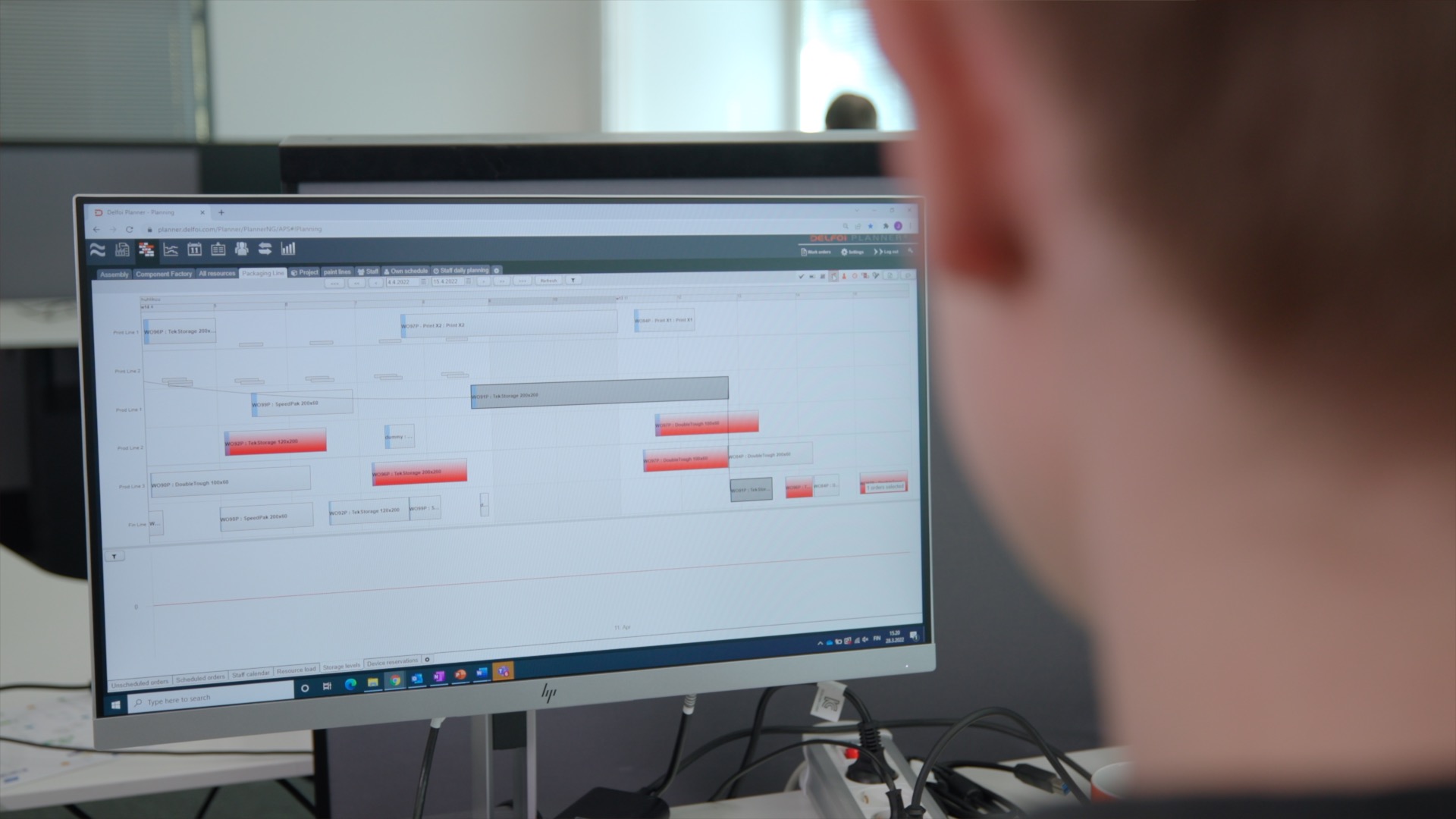
Infinite capacity planning assumes unlimited resources and builds schedules without accounting for real-world constraints like machine availability or workforce limits. Finite capacity planning works within actual resource boundaries, generating schedules that reflect what your operation can realistically deliver. The right method depends on your production environment, your need for delivery accuracy, and how closely your planning needs to reflect shop floor reality. The sections below unpack each method in depth and help you decide which approach fits your situation.
Which capacity planning method suits your production environment?
The best capacity planning method depends on the complexity of your production environment and the accuracy your customers expect from delivery promises. Simpler, high-volume environments with predictable demand may function adequately with infinite capacity planning as a starting point. Operations with constrained resources, mixed product types, or tight delivery commitments generally need finite capacity planning to produce reliable schedules.
A useful way to assess this is to ask one question: how often do your promised delivery dates actually hold? If your team regularly revises quotes after orders are placed, or if production managers spend significant time manually adjusting schedules to account for machine downtime, operator availability, or tooling conflicts, your environment is telling you it needs constraint-aware scheduling. The more variables your shop floor carries, the less reliable an unconstrained model becomes.
It is also worth considering your planning horizon. Short-run, make-to-stock environments with stable routings can tolerate more approximation. Make-to-order manufacturers, job shops, and operations running multiple product families through shared resources have much less room for error and benefit most from finite scheduling logic.
How does infinite capacity planning calculate production schedules?
Infinite capacity planning calculates production schedules by working backward or forward from a demand signal without applying any resource limits. It assumes that every work center, machine, and operator is always available at full capacity. The schedule is built purely from routing times, lead times, and order quantities, producing a theoretical timeline that ignores whether the resources needed actually exist in the required quantities at the required time.
This approach is common in Material Requirements Planning systems, where the primary goal is to determine what needs to be produced and when, rather than whether it can realistically be produced within current capacity. The output is a planned order schedule that tells you the ideal sequence and timing, but it does not flag overloads or bottlenecks automatically.
Infinite capacity planning is computationally straightforward, which makes it fast and easy to run across large product ranges. It works well as a demand-shaping tool, helping planners understand aggregate load over a longer horizon before they apply manual adjustments to level the schedule. The limitation is that those manual adjustments are always required before the schedule reaches the shop floor.
How does finite capacity planning account for real-world constraints?
Finite capacity planning accounts for real-world constraints by loading each resource only up to its actual available capacity before scheduling the next operation. It factors in machine hours, operator shifts, setup times, maintenance windows, and any other defined limits when building the production sequence. The result is a schedule that reflects what can genuinely be produced, not just what has been ordered.
When a finite scheduling engine for production planning encounters a resource conflict, it resolves it using priority rules, sequencing logic, or optimization algorithms rather than simply stacking work on top of an already full resource. This means the schedule automatically reflects bottlenecks, queues, and realistic lead times without requiring planners to manually identify and resolve every conflict.
The practical impact on customer-facing operations is significant. Because the schedule is built from actual resource availability, the delivery dates it produces are grounded in reality. When a customer asks for a delivery date, the answer comes from the capacity you actually have, so the quote holds rather than shifting as the order moves through production. This is one of the most direct ways finite capacity planning improves both operational reliability and customer trust.
What are the limitations of infinite capacity planning in manufacturing?
The core limitation of infinite capacity planning in manufacturing is that it produces schedules that cannot be executed as planned. Because it ignores resource constraints, the schedule it generates will almost always contain overloads at certain work centers, creating a gap between the planned timeline and what the shop floor can actually deliver. Planners must then manually intervene to resolve these conflicts before the schedule becomes workable.
This gap between plan and reality creates several downstream problems:
- Unreliable delivery promises: Dates built on theoretical capacity change constantly as planners adjust for real constraints, which erodes customer confidence.
- Reactive planning: Teams spend time firefighting schedule conflicts rather than proactively managing production flow.
- Hidden bottlenecks: Without constraint visibility, recurring capacity problems are addressed individually rather than resolved structurally.
- Inventory distortion: Overloaded work centers cause work-in-progress to queue unpredictably, making it harder to manage material flow and stock levels.
Infinite capacity planning also becomes increasingly unreliable as product mix complexity grows. A simple, repetitive production environment can absorb its approximations more easily. A job shop running dozens of different routings through shared resources will find that the gap between the infinite plan and shop floor reality grows large enough to make the plan almost unusable without substantial manual correction.
When should a manufacturer switch to finite capacity planning?
A manufacturer should switch to finite capacity planning when the gap between planned and actual delivery dates becomes a recurring problem, when manual schedule adjustments consume significant planner time, or when resource constraints are complex enough that an unconstrained model no longer reflects production reality. These are signs that the planning method has become the limiting factor in operational performance.
Specific triggers that indicate the need for a switch include:
- Delivery promises that regularly shift after orders are confirmed
- Planners spending more time adjusting schedules than managing exceptions
- Bottleneck resources that are consistently overloaded in the plan but underutilized in practice, or vice versa
- Growth in product variety or order complexity that outpaces the capacity of manual adjustment
- Customer pressure for shorter, more reliable lead times
The switch does not need to be abrupt. Many manufacturers begin by applying finite scheduling logic to their most constrained resources while continuing to use infinite planning for less critical work centers. This staged approach lets teams build confidence in the new method and validate its outputs before rolling it out across the full operation.
Can infinite and finite capacity planning be used together?
Yes, infinite and finite capacity planning can be used together, and in practice many manufacturing environments benefit from using both at different stages of the planning process. Infinite capacity planning works well as a high-level demand and load analysis tool, while finite capacity planning is applied closer to execution to generate a schedule the shop floor can actually follow.
A common pattern is to use infinite planning at the sales and operations planning level to model demand scenarios and assess aggregate load over a rolling horizon. This gives leadership a fast, flexible way to evaluate capacity needs without the computational overhead of full finite scheduling. When orders are confirmed and need to be sequenced for production, finite scheduling takes over and builds the detailed, constraint-aware schedule.
This layered approach works because the two methods serve different questions. Infinite planning answers whether the operation has enough capacity in aggregate over a period. Finite planning answers how that capacity should be allocated across specific orders, resources, and time slots to meet commitments reliably. Using them together means you get the speed and flexibility of unconstrained modeling at the strategic level and the accuracy of constraint-aware scheduling at the operational level.
We work with manufacturers who use exactly this kind of layered structure, and the combination consistently produces better planning outcomes than either method used in isolation. The key is being clear about which decisions each method is informing and not using an infinite plan as the basis for shop floor execution without first applying finite logic to validate it. Contact us to discuss your planning needs and find out how this approach can work for your operation.