Reducing lead times is one of the most common goals in manufacturing. Yet in many factories, it remains difficult to achieve.
The reason is not a lack of effort or efficiency. It is how production is planned.
In many environments, production is still guided at a weekly or daily level. Orders move from one operation to the next with built-in delays. As a result, actual value-adding work may represent only a small fraction of total lead time, while the rest is waiting.
If lead times are to be reduced, this has to change.
Lead time is mostly waiting time
In most production environments, lead time is not determined by processing time. It is determined by waiting.
In discrete manufacturing with long lead times, value-adding process time is typically less than 5% of the total lead time. The rest of the time, the product is waiting between operations.
Orders spend days or weeks between operations, even when the actual work takes only hours. These delays are often not visible in planning, but they define delivery performance.
This is why improving lead time is not about increasing speed. It is about removing unnecessary waiting between operations.
To achieve this, production must be scheduled at a much more detailed level. Instead of planning in days or weeks, operations need to be sequenced in a way that allows work to flow continuously from one stage to the next.
The hidden drivers of WIP
Work in progress is not a random outcome. It is a direct consequence of how work is released and scheduled.
Three patterns are especially common:
- Work is released too early, without considering downstream capacity
- Batch sizes are increased to improve local efficiency
- Operation times are inaccurate, which leads to unnecessary time buffers between operations
- Operations are planned on daily basis
Each of these decisions may make sense locally. Together, they create queues, increase waiting time and drive up both lead times and WIP.
Reducing WIP is therefore not a separate task. It is a result of better flow.
From coarse planning to finite scheduling
When production is planned only at a rough level, delays between operations are unavoidable. Work is completed in one step and then waits for the next operation, often planned for the following day.
These delays are not always visible in planning, but they accumulate across the process and extend overall lead time.
At this level of planning, it is simply not possible to coordinate operations tightly enough to avoid waiting.
The fundamental shift is not from low efficiency to high efficiency. It is from coarse planning to precise, operation-level control.
With finite scheduling, operations are sequenced in detail so that each step can start as soon as the previous one finishes. This reduces unnecessary waiting while maintaining the utilisation of critical resources.
What actually changes in practice
When production is scheduled at an operation level with real capacity constraints, the impact is visible quickly.
Lead times become shorter because waiting between operations is reduced. At the same time, WIP decreases as less material is sitting idle in the system.
Production process efficiency also improves. In many cases, the share of value-adding time can increase from around 5% to up around 20% of total lead time in long, multi-operation production processes.
There is also a clear relationship between lead time and WIP. As lead time is reduced, WIP typically decreases significantly as well. In practice, reductions in lead time often lead to substantial reductions in WIP, as described in production planning literature.
Just as importantly, planning becomes more predictable. Instead of reacting to delays after they occur, planners can see where constraints will emerge and adjust before they impact delivery.
Questions manufacturers are asking
These challenges are usually recognised through practical questions:
How can we reduce lead times in production?
By reducing waiting between operations. This requires moving from coarse, time-based planning to detailed, operation-level finite scheduling.
How can we minimise WIP?
By controlling when work is released and ensuring that it flows without unnecessary delays. Shorter lead times naturally lead to lower WIP.
Why does high utilisation not improve delivery performance?
Because maximising utilisation at individual resources often creates queues elsewhere. The overall system slows down even while machines stay busy. High utilisation still matters at the bottleneck, where it protects throughput. In high‑mix production, however, the bottleneck can shift with current demand.
Why is it difficult to react to disruptions like machine breakdowns?
Because the impact of changes is not visible. Without a realistic, constraint-based plan, decisions are made without understanding their consequences.
Do we need APS if we already use ERP and Excel?
ERP systems manage data, but they don’t provide detailed scheduling logic. Excel can work in stable environments, but it doesn’t scale well as complexity grows. In changing situations, Excel also requires a lot of manual effort and still won’t produce reliable delivery schedules. APS adds a dynamic, capacity‑aware view of production, with minute‑level visibility into operations and delivery dates.
Why APS and why Delfoi Planner
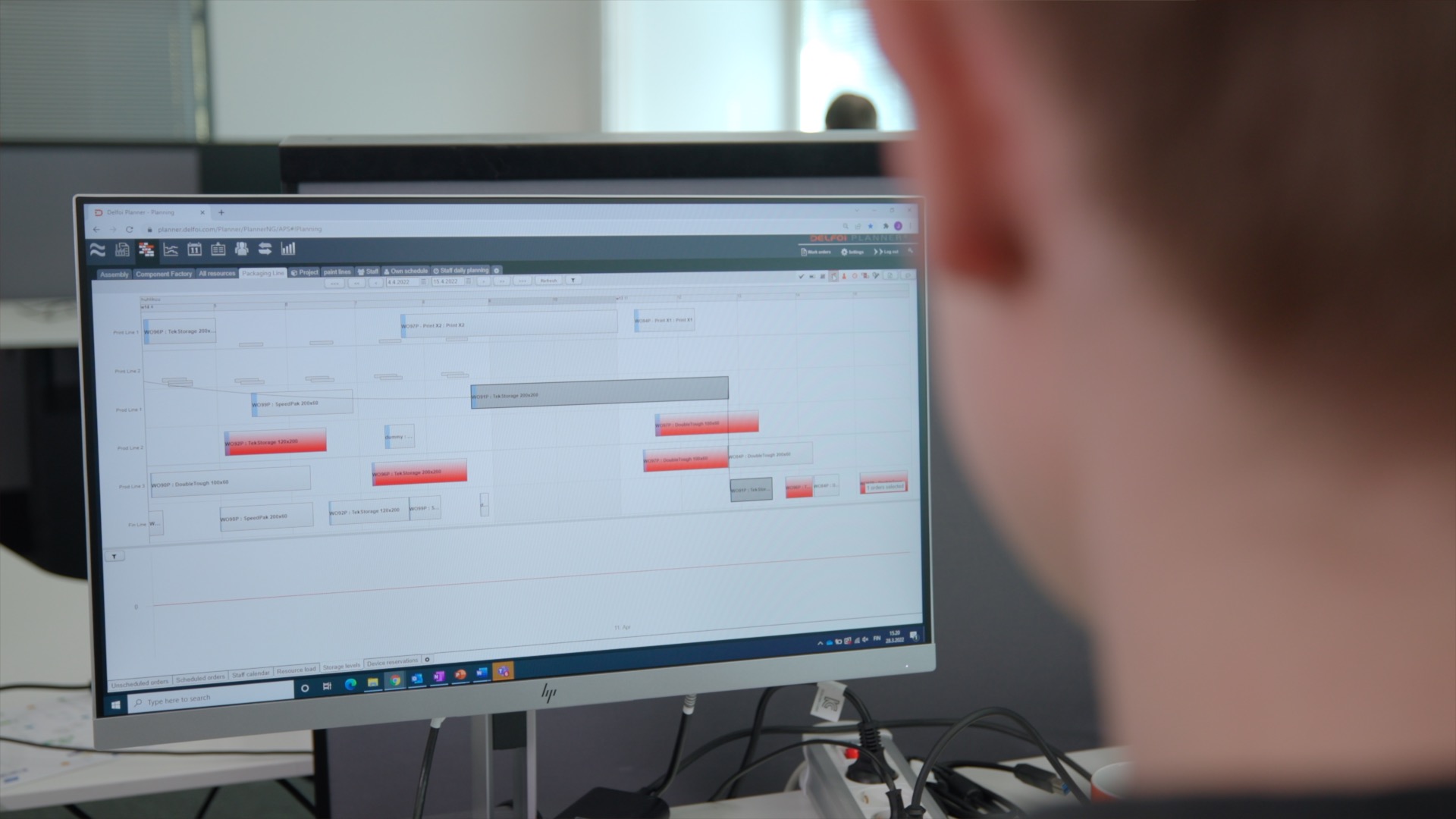
The value of APS is not only in producing a schedule. It is in making production flow visible and controllable.
Instead of planning at a high level and reacting later, planners can:
- see how operations are sequenced in detail
- understand how delays propagate through the system
- evaluate alternatives before making decisions
Solutions like Delfoi Planner are designed specifically for finite scheduling in complex production environments. They combine detailed scheduling with visual planning, allowing production to be managed at the level where delays actually occur. This is particularly important in complex environments.
For example, companies like Valmet (read the reference story) operate in complex environments with multiple products, long lead times and changing priorities. In such conditions, planning based on averages is not enough. Detailed scheduling and visibility are required to maintain control.
Their use of Delfoi Planner reflects a broader shift in manufacturing: moving from reactive planning to controlled, data-driven flow management.
The real competitive advantage
In the end, the competitive advantage does not come from faster machines or higher utilisation. It comes from the ability to control production flow, which aligns closely with lean manufacturing principles.
Shorter lead times mean faster deliveries, lower working capital and improved competitiveness through faster response to customer demand. That is what ultimately differentiates high-performing manufacturing operations.