Production planners spend most of their day firefighting because the gap between the plan and reality is almost always wider than the tools they use can bridge. When a machine breaks down, a supplier delivers late, or a rush order lands without warning, the plan becomes outdated instantly, and without real-time visibility or fast replanning capabilities, the only option is to react manually. The sections below break down exactly why this happens and what it takes to escape the cycle.
What does ‘firefighting’ actually mean in production planning?
In production planning, firefighting means spending the majority of your working time responding to disruptions rather than planning ahead. Instead of managing a stable, forward-looking schedule, planners are constantly rearranging orders, chasing information, and patching up a plan that reality has already broken. The work becomes reactive by default, not by choice.
The term captures something important: firefighters do not prevent fires, they put them out. A production planner stuck in firefighting mode is doing the same thing, showing up to each new crisis with a bucket rather than working on the systems that would stop the fire from starting. The result is a planner who is perpetually busy but rarely productive in the way that actually moves the operation forward.
This matters because firefighting is not just stressful for the individual planner. It creates a compounding problem across the shop floor. Every manual adjustment made in response to one disruption can create new conflicts downstream, which then require further adjustments, and the cycle repeats.
What causes production planners to work reactively?
Production planners work reactively because the gap between what was planned and what is actually happening on the floor widens faster than most planning processes can keep up with. Disruptions such as machine downtime, material shortages, absent staff, and last-minute customer changes are a constant feature of manufacturing, and when the planning process is not built to absorb them quickly, reaction becomes the default mode.
A few root causes consistently drive reactive planning across manufacturing environments:
- Infrequent replanning cycles: When schedules are only updated weekly, or only when things get bad enough to force action, the plan is almost always out of date.
- Lack of real-time information: If a planner does not know a machine has gone down until hours later, every decision made in the meantime is based on faulty assumptions.
- No clear view of downstream impact: When a change to one order is made in isolation, without visibility into how it affects other orders, the fix creates new problems.
- Overreliance on individual knowledge: When the plan lives in someone’s head or in a spreadsheet only they fully understand, the whole operation becomes fragile.
None of these causes are inevitable. They are symptoms of planning processes and tools that were not designed to handle the pace and complexity of modern manufacturing.
How does poor data visibility trap planners in reactive mode?
Poor data visibility traps production planners in reactive mode because decisions made without accurate, up-to-date information are almost always wrong in some way, and correcting those decisions takes time that should have been spent on forward planning. When planners cannot see the current state of the shop floor clearly, they are essentially navigating with an outdated map.
The problem compounds quickly. A planner who does not know in real time which machines are running, which orders are behind, or where material bottlenecks are forming cannot make confident scheduling decisions. Instead, they wait for problems to surface, often through a phone call or a complaint, and then react. This delay between a disruption occurring and a planner becoming aware of it is where a significant portion of firefighting originates.
Visibility also affects confidence. When planners know their data is unreliable or stale, they tend to build in extra buffer, avoid committing to tight schedules, and spend time verifying information that should already be available. All of that is time not spent on planning. Improving data visibility is therefore not just a technical upgrade; it is one of the most direct ways to give planners the conditions they need to work proactively.
Why do manual planning tools make firefighting worse?
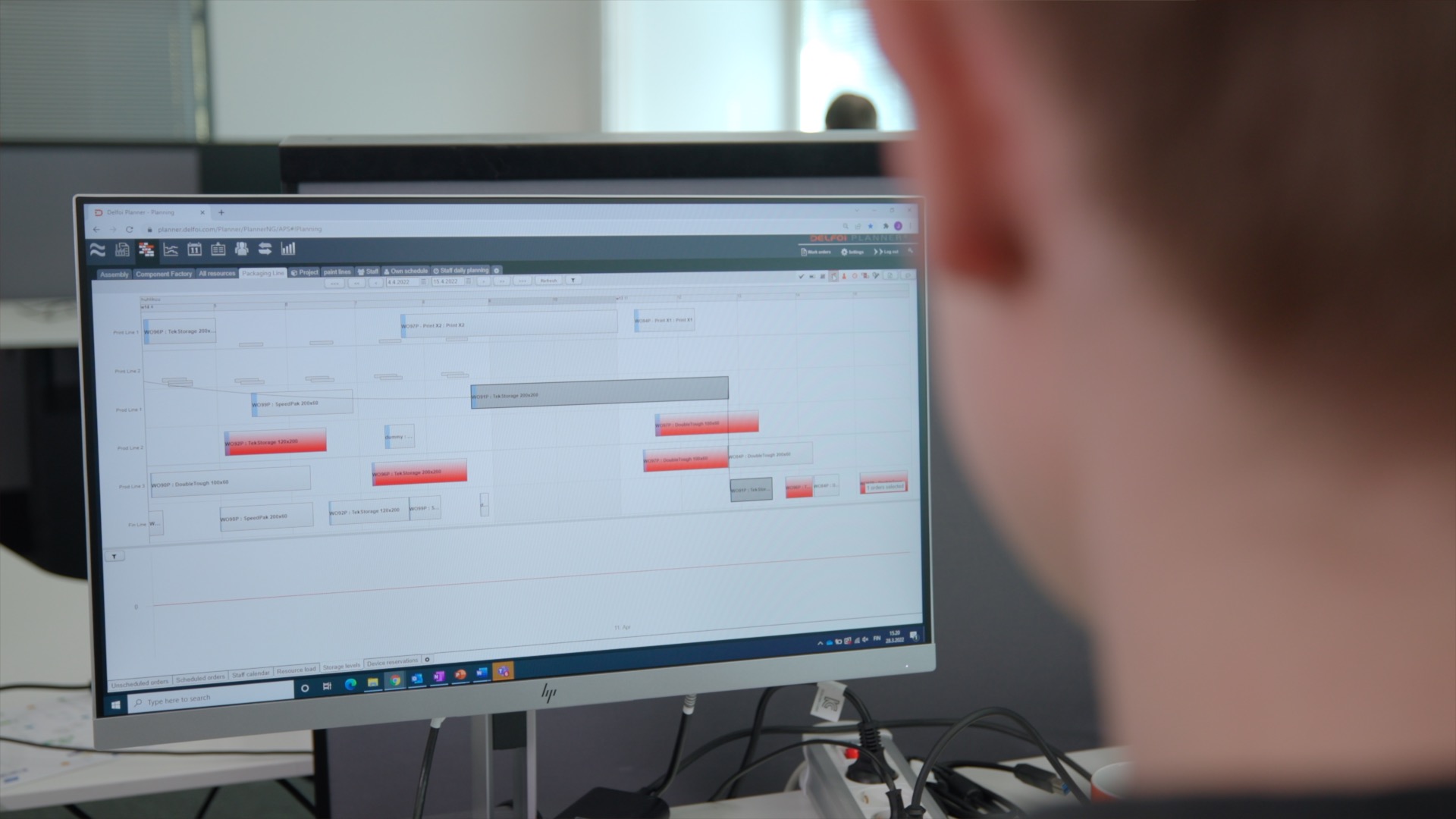
Manual planning tools make firefighting worse because they cannot keep pace with the rate at which disruptions occur in a real manufacturing environment. Spreadsheets and whiteboards require a human to update every change, calculate every knock-on effect, and communicate every adjustment. When disruptions happen frequently, as they do in most production environments, the manual effort required to maintain an accurate plan becomes impossible to sustain.
The core issue is speed and ripple visibility. When a planner needs to reschedule one order manually, they also need to check every other order that shares the same machine, the same materials, or the same delivery window. In a spreadsheet, that means scrolling, cross-referencing, and recalculating by hand. By the time the adjustment is complete, another disruption may already have arrived.
Manual tools also make it harder to communicate changes to the people who need to act on them. A revised schedule that lives in a planner’s spreadsheet does not automatically reach the shop floor supervisor, the purchasing team, or the customer service team. That communication lag creates further gaps between plan and reality, which generate more firefighting further down the line.
What’s the difference between reactive and proactive production planning?
Reactive production planning means responding to disruptions after they have already affected the schedule. Proactive production planning means anticipating potential problems before they occur and building the flexibility to absorb disruptions without breaking the plan. The difference is not about eliminating uncertainty; it is about having the tools and processes to respond to uncertainty faster and with less damage.
In reactive mode, the planner’s primary job becomes rearranging what has already gone wrong. In proactive mode, the planner’s job is to maintain a schedule that is always close enough to reality that small disruptions do not trigger a cascade of manual fixes. The plan is treated as a living document, updated continuously rather than periodically.
Proactive planning also changes the nature of the planner’s role. Rather than spending the day putting out fires, a proactive planner spends time on scenario analysis, capacity optimization, and anticipating future bottlenecks. That shift in focus tends to produce better outcomes for the business and significantly less stress for the planner.
How can production planners reduce time spent firefighting?
Production planners can reduce time spent firefighting by closing the gap between the plan and reality as quickly as possible, which requires real-time data, faster replanning capability, and visibility into how changes ripple across the full schedule. No single change eliminates firefighting entirely, but the right combination of process and tooling can dramatically reduce how much of the day it consumes.
The most effective steps tend to follow a clear pattern:
- Establish real-time shop floor visibility: Planners need to know what is actually happening on the floor as it happens, not hours later. This is the foundation everything else depends on.
- Move from weekly to continuous replanning: Updating the schedule only once a week guarantees it will be out of date most of the time. The goal is to make replanning fast enough that it can happen whenever reality changes.
- Understand ripple effects before committing to changes: Any rescheduling decision should be evaluated against its downstream impact before it is applied. Without this, fixing one problem creates two more.
- Reduce dependence on individual knowledge: When the plan is transparent and accessible to everyone who needs it, the whole team can respond to disruptions, not just the one planner who holds all the information.
- Build change management into the planning process: Disruptions are not exceptional events; they are a normal part of manufacturing. Planning processes that treat them as exceptions will always struggle to handle them well.
This is exactly the kind of challenge we work on with manufacturers every day. With the right production scheduling system for manufacturers in place, rescheduling becomes a matter of minutes rather than hours, and the ripple effects of any change are visible immediately, so planners can reprioritize with confidence rather than guesswork. The goal is not a perfect plan that never changes. It is a planning process agile enough that changes do not cost the whole day. Get in touch with our planning specialists to find out how we can help your team spend less time firefighting and more time planning ahead.