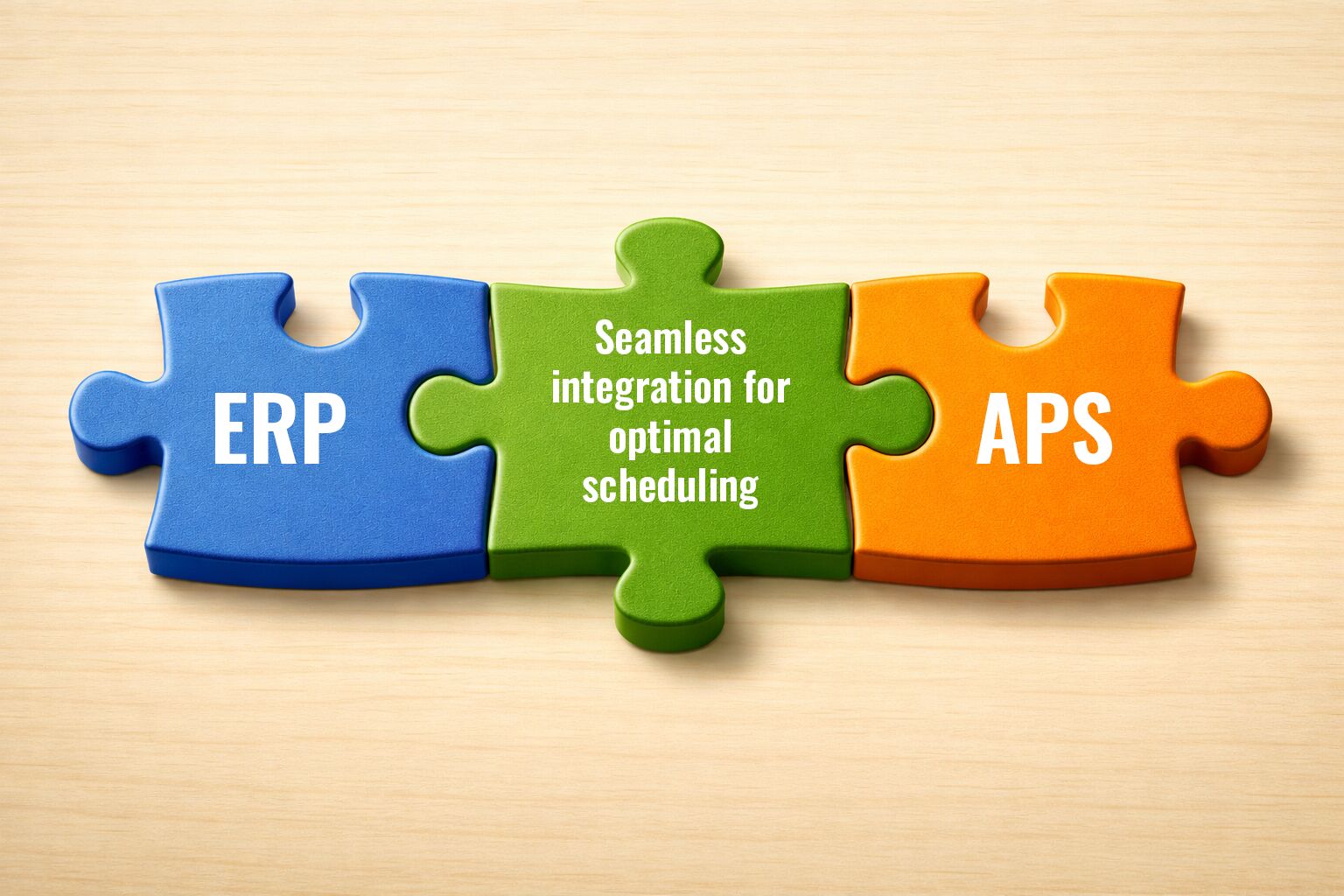
Manufacturing companies using Oracle NetSuite often discover that while their ERP system excels at managing financial transactions and basic inventory, it struggles with the complex demands of production planning. The gap between NetSuite’s core ERP functionality and the sophisticated scheduling requirements of modern manufacturing creates bottlenecks that spreadsheets simply cannot solve. Understanding how to bridge this gap with advanced planning and scheduling capabilities can transform your production operations from reactive to predictive, delivering measurable improvements in efficiency and delivery performance.
Why NetSuite’s native planning falls short for manufacturers
Oracle NetSuite provides robust ERP functionality for financial management, order processing, and basic inventory control, but its native planning capabilities were not designed to handle the intricate demands of modern manufacturing operations. The system excels at tracking what has happened but struggles with optimising what should happen next.
The most significant limitation lies in capacity planning. NetSuite’s standard functionality cannot perform finite capacity scheduling, meaning it cannot account for machine availability, labour constraints, or bottleneck resources when generating production schedules. This forces manufacturers to rely on infinite capacity assumptions that rarely reflect shop floor reality.
Real-time production control presents another challenge. While NetSuite tracks work orders and inventory movements, it lacks the visual interfaces and immediate feedback mechanisms that production managers need to respond quickly to disruptions. When a machine breaks down or a priority order arrives, the system cannot automatically reoptimise the remaining schedule to minimise the impact.
The scheduling optimisation gap becomes particularly apparent in complex manufacturing environments with multiple production lines, varying setup times, and interdependent processes. NetSuite’s basic scheduling logic cannot handle constraint-based optimisation or perform the sophisticated calculations needed to balance competing priorities such as delivery dates, resource utilisation, and inventory levels.
How Delfoi Planner transforms NetSuite into a manufacturing powerhouse
Rather than replacing NetSuite, Delfoi Planner for NetSuite seamlessly extends your existing ERP investment with advanced APS planning capabilities. This integration approach preserves your NetSuite workflows while adding the sophisticated production scheduling and optimisation features that manufacturers need.
The transformation occurs through direct integration with NetSuite’s master data. Bills of materials, routings, work orders, resource calendars, and inventory levels flow automatically into the planning environment, eliminating manual data entry and ensuring that planning decisions are based on current information. This connection means your familiar NetSuite processes continue unchanged while gaining powerful new capabilities.
Visual planning interfaces replace the spreadsheet chaos that many manufacturers still endure. Drag-and-drop Gantt charts and planning boards enable production planners to visualise entire schedules, identify bottlenecks instantly, and reoptimise plans in response to changes. The system can shorten lead times by up to 50% while improving delivery accuracy through better visibility and control.
The optimisation algorithms work behind the scenes to solve complex scheduling problems that would take hours to resolve manually. These intelligent systems can increase capacity utilisation by 25–50% by identifying and eliminating inefficiencies in resource allocation, setup sequences, and production flows.
Essential APS features that complement NetSuite’s ERP core
Advanced Planning and Scheduling capabilities fill the gaps in NetSuite’s standard functionality with sophisticated tools designed specifically for manufacturing environments. Finite capacity scheduling ensures that production plans respect actual resource constraints rather than assuming unlimited capacity.
Constraint-based optimisation algorithms automatically balance multiple competing objectives. The system can simultaneously optimise for delivery performance, resource utilisation, inventory levels, and setup efficiency, finding solutions that human planners might miss. This capability proves particularly valuable in complex manufacturing environments with multiple product lines and shared resources.
What-if scenario planning enables manufacturers to evaluate alternative strategies before committing to changes. Production managers can simulate the impact of rush orders, equipment maintenance, or capacity adjustments to make informed decisions. This predictive capability transforms reactive firefighting into proactive planning.
Real-time production visibility extends beyond NetSuite’s standard reporting with live dashboards showing work in progress, bottleneck status, and performance metrics. Shop floor personnel can confirm production progress, report issues, and track KPIs through intuitive visual interfaces that complement NetSuite’s data capture.
The integrated Manufacturing Execution System (MES) functionality provides shop floor control capabilities that NetSuite lacks natively. This includes production confirmation, quality tracking, and real-time progress monitoring that feeds back into both the planning system and NetSuite’s financial records.
What makes seamless NetSuite integration possible with Delfoi
The integration architecture preserves NetSuite’s familiar interface while extending it with sophisticated planning capabilities. As a certified SuiteApp, the solution reduces custom coding requirements and accelerates deployment timelines compared with standalone systems that require complex integration projects.
Data synchronisation occurs automatically between NetSuite and the planning environment. Master data updates flow seamlessly in both directions, ensuring consistency without manual intervention. Work order status changes, inventory movements, and production confirmations update both systems simultaneously, maintaining data integrity across the entire operation.
Workflow preservation means existing NetSuite processes continue unchanged. Users access planning functionality through familiar NetSuite navigation while maintaining their established approval processes, security settings, and reporting structures. This continuity reduces training requirements and user resistance to new functionality.
The cloud-based architecture complements NetSuite’s SaaS model perfectly. Both systems benefit from automatic updates, scalable infrastructure, and enterprise-grade security without requiring additional IT infrastructure or maintenance overhead. This alignment ensures consistent performance and reliability across the integrated solution.
User experience continuity extends NetSuite’s interface philosophy with intuitive visual planning tools. The drag-and-drop scheduling boards and graphical dashboards feel natural to NetSuite users while providing the advanced functionality that manufacturing operations demand. This design approach minimises learning curves and maximises user adoption.
Understanding NetSuite planning limitations and available solutions empowers manufacturers to make informed decisions about their production planning strategy. The combination of NetSuite’s proven ERP capabilities with advanced APS functionality creates a comprehensive platform that addresses both transactional and operational requirements. This integrated approach delivers measurable improvements in planning efficiency, delivery performance, and operational transparency while preserving existing investments and workflows.