When ERP plans with infinite capacity, it creates schedules that look realistic on paper but fall apart the moment they reach the shop floor. The system assumes every machine, operator, and workstation is always available and never overloaded, so it assigns work orders to time slots without ever checking whether the actual resources can handle the load. The sections below break down exactly why this happens, what it costs manufacturers, and what a better approach looks like.
Why does ERP default to infinite capacity planning?
ERP systems default to infinite capacity planning because their core scheduling logic was designed around materials, not constraints. The system backward-schedules from a due date using fixed lead times and assumes that if the materials are available, production can happen. It never checks whether the machine is already booked, the operator is on another shift, or the tooling is in maintenance.
This design choice made sense when ERP systems were first built. Their primary job was inventory and order management, not detailed production scheduling. Capacity checking adds significant computational complexity, and in early implementations, the data required to model real shop floor constraints simply was not available in a structured way. The result is a planning engine that is excellent at answering “what do we need?” but poorly equipped to answer “can we actually do this, and when?”
Most manufacturers accept this as a known limitation and work around it manually, which is where the real inefficiencies begin to accumulate.
What problems does infinite capacity planning cause on the shop floor?
Infinite capacity scheduling creates a fundamental disconnect between the plan and reality. Because the ERP never checks resource availability, it routinely assigns more work to a time period than a work center can physically complete. Supervisors arrive at the start of a shift to find a queue of orders that are all theoretically due at the same time, with no guidance on what to run first.
The practical consequences compound quickly. Teams spend significant time each day making informal prioritization decisions that the planning system should have made. Work-in-progress builds up in front of bottleneck machines while other areas sit idle. Expediting becomes a daily routine rather than an exception, and the informal knowledge required to keep things moving becomes concentrated in a few experienced individuals rather than embedded in the system itself.
Over time, this creates a planning culture where the official schedule is treated as a starting point for negotiation rather than a reliable guide. That erosion of trust in the plan makes it even harder to introduce discipline or improve performance systematically.
How does infinite capacity planning affect delivery reliability?
Infinite capacity planning directly undermines delivery reliability because the promised dates it generates are not grounded in what the shop floor can actually achieve. When ERP backward-schedules from a customer due date without checking resource availability, it produces a commit date that assumes ideal conditions throughout. Any real-world constraint, a machine queue, a missing component, an absent operator, immediately invalidates that date.
For manufacturers, this creates a painful cycle. Sales commits to dates based on ERP output. Production misses those dates because the schedule was never achievable. Customer service scrambles to manage expectations. The root cause, a planning system that never modeled real capacity, remains unaddressed.
Delivery reliability is one of the most visible competitive differentiators in manufacturing. Customers who cannot trust your due dates will eventually find a supplier they can trust. The damage from poor delivery performance compounds in ways that go well beyond individual late orders.
What is the difference between infinite and finite capacity planning?
The core difference is whether the planning system respects resource limits. Infinite capacity planning assigns work orders to a schedule based on lead times and material availability, treating every resource as if it has unlimited capacity. Finite capacity planning builds the schedule around actual resource constraints, ensuring that no machine, operator, or workstation is assigned more work than it can realistically complete in a given period.
How infinite capacity planning works
In an infinite capacity model, the system calculates when an order needs to start based on its due date and standard lead times. It does not check whether a machine is already occupied, whether an operator is scheduled, or whether a bottleneck exists. The plan is theoretically clean but practically unreliable. It answers the question “when should this happen?” without ever asking “is this actually possible?”
How finite capacity planning works
Finite capacity planning models the actual constraints of the production environment, including machine availability, operator shifts, tooling requirements, and material readiness, and sequences work orders accordingly. When a resource is fully loaded, the system pushes work to the next available slot rather than stacking orders on top of each other. The resulting schedule is achievable because it was built against reality from the start.
When should manufacturers move beyond ERP capacity planning?
Manufacturers should move beyond ERP capacity planning when the gap between the planned schedule and actual shop floor performance becomes a persistent operational problem rather than an occasional exception. Several specific signals indicate that the built-in scheduling logic is no longer sufficient.
- Chronic late deliveries despite what appears to be adequate lead time in the system
- Daily expediting as a normal part of production management rather than a response to genuine emergencies
- Supervisor overrides where experienced staff routinely resequence work because the printed schedule is unworkable
- High work-in-progress inventory building up in front of bottleneck resources
- Inability to give reliable delivery dates to customers without significant manual checking
- Increasing product mix complexity that makes manual workarounds harder to sustain
The common thread in all of these signals is that the planning system is no longer providing actionable guidance. People are compensating for its limitations through informal knowledge and manual effort, which is both fragile and difficult to scale.
How can APS software fix what ERP capacity planning misses?
Advanced Planning and Scheduling (APS) software fixes the core gap in ERP capacity planning by layering constraint-based, finite scheduling on top of the ERP’s order and materials data. Where the ERP produces a schedule that ignores resource limits, an APS system models real machines, operator availability, tooling, and materials to generate a sequence that is actually executable on the shop floor.
The practical mechanism works like this: the APS pulls order and materials data from the ERP, applies finite capacity logic against the real production environment, and writes achievable dates back into the ERP. Sales and planning teams see commit dates that reflect what production can genuinely deliver, not what an unconstrained algorithm calculated in isolation.
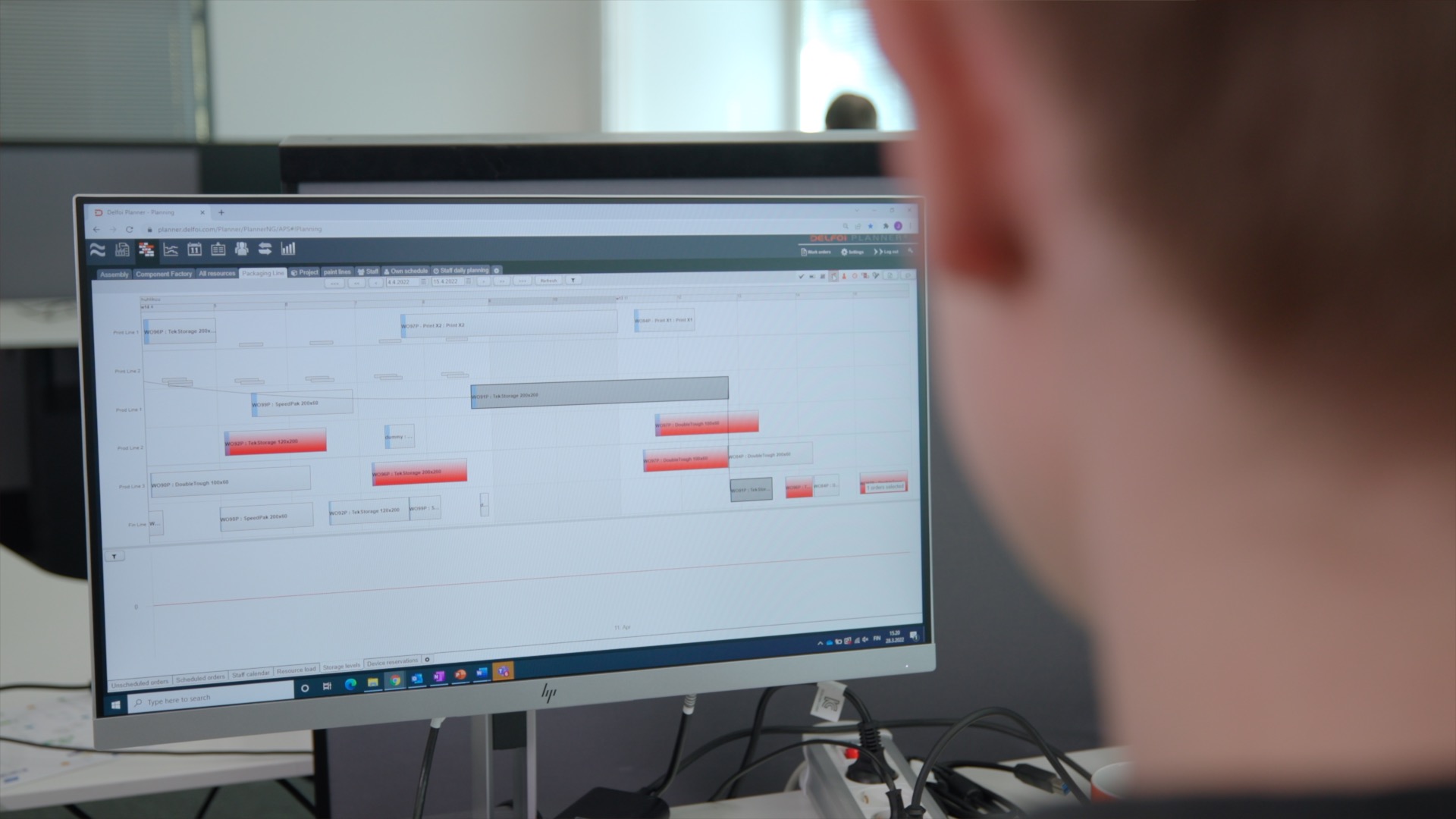
This is exactly the approach we take at Delfoi. Our APS software sits alongside your existing ERP rather than replacing it, adding the constraint-aware scheduling layer that ERP systems were never designed to provide. The result is a schedule that supervisors can actually follow, delivery dates that customers can rely on, and a planning process that improves visibility across the entire production operation.
Beyond scheduling accuracy, Delfoi Planner also supports faster response to change. When a machine goes down, a rush order arrives, or a supplier delivers late, the system can reschedule around the disruption immediately rather than waiting for a manual replanning cycle. That responsiveness is increasingly important in 2026, as manufacturers face shorter lead time expectations and greater variability in demand. To learn more about how finite capacity scheduling can work in your environment, contact our team for a consultation.