Selecting the right Advanced Planning and Scheduling (APS) solution is a critical decision that can transform your manufacturing operations. However, many organizations hesitate to move forward due to concerns about implementation risks, costs, and potential disruption to ongoing production. The good news is that you don’t need to commit to a full-scale implementation to properly evaluate an APS solution.
Smart manufacturers are discovering ways to thoroughly test production planning software capabilities without exposing their operations to unnecessary risk. By taking a strategic approach to APS solution evaluation, you can make confident decisions based on real-world performance data rather than vendor promises alone.
What Is an APS Solution and Why Does Evaluation Matter?
An APS solution is advanced production planning software that optimizes manufacturing schedules using intelligent algorithms, real-time data, and finite-capacity constraints. Unlike traditional planning methods, APS production scheduling and optimization systems automatically balance workloads, minimize bottlenecks, and adapt to changing production demands while accounting for resource availability, material constraints, and delivery requirements.
Proper evaluation matters because APS implementation represents a significant investment of both time and resources. The wrong choice can lead to months of disrupted operations, frustrated staff, and missed productivity goals. Manufacturing organizations need confidence that their chosen solution will deliver measurable improvements in efficiency, delivery performance, and operational visibility.
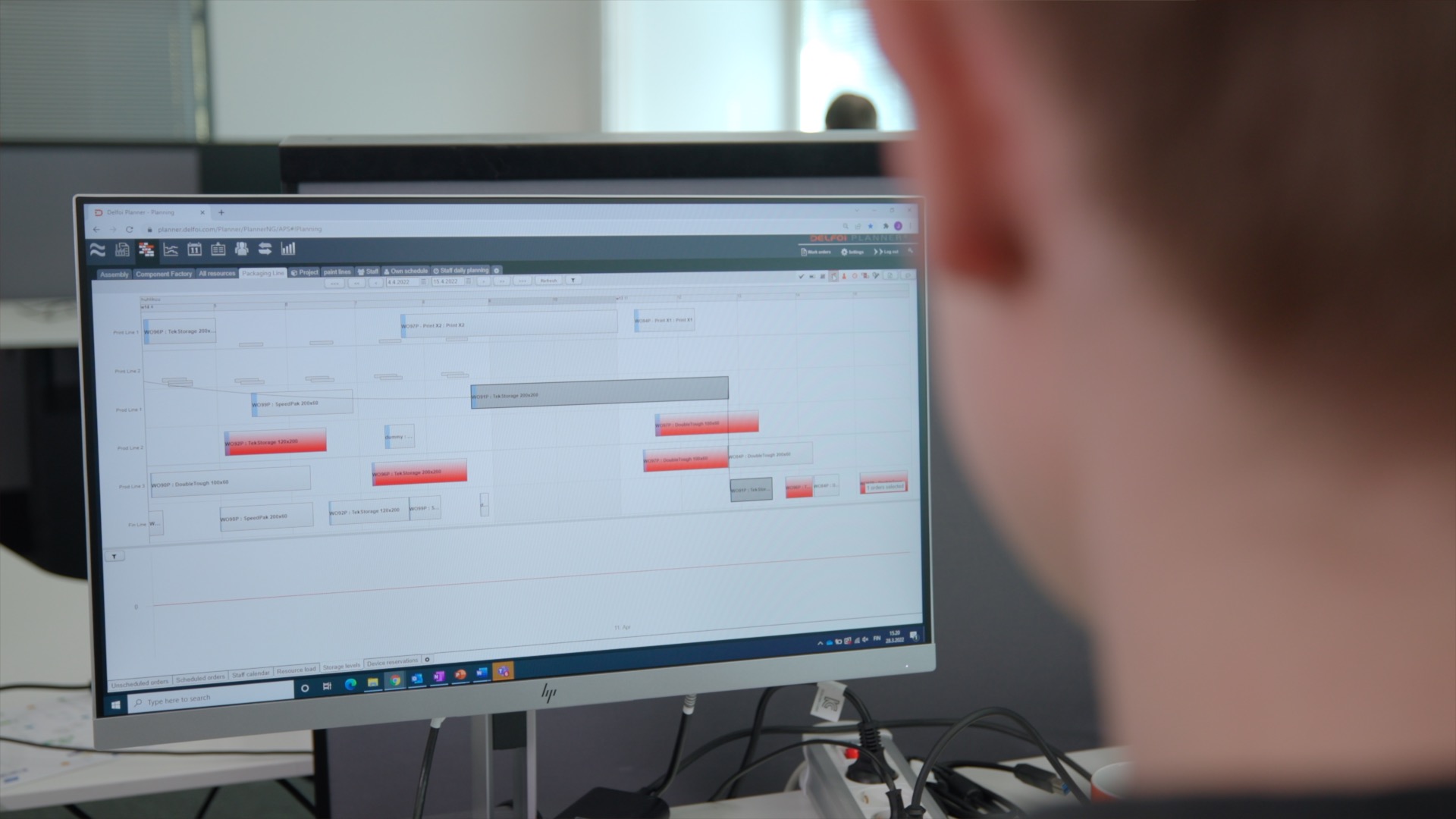
Modern APS solutions like Delfoi Planner combine intelligent scheduling algorithms with intuitive drag-and-drop interfaces, making complex production planning more accessible while maintaining sophisticated optimization capabilities. Delfoi Planner is a proven, visual planning solution with native connectivity to major ERP systems. For NetSuite users, the tested integration provides a straightforward path to advanced planning and scheduling without long development projects. The solution suits discrete manufacturing, make-to-order, make-to-stock, and project-based operations.
Connected to Your NetSuite Master Data
Delfoi Planner for NetSuite integrates seamlessly with your NetSuite ERP. Bills of materials, routings, work orders, resource calendars, and inventory levels flow automatically into the planning environment, ensuring up-to-date data and eliminating the need for spreadsheets. These systems integrate seamlessly with existing ERP platforms, ensuring data consistency across your manufacturing ecosystem.
What Are the Main Risks of Full APS Implementation?
A full APS implementation carries substantial operational risks, including production disruption, data migration challenges, staff resistance to new workflows, and potential system incompatibilities that can halt manufacturing operations. These risks are amplified when organizations lack proper evaluation and preparation phases.
The most significant risk is operational disruption during the transition period. When production planning systems fail or perform poorly, the entire manufacturing operation suffers. Orders are delayed, resources are misallocated, and customer relationships deteriorate. This is particularly dangerous in high-mix manufacturing environments, where scheduling complexity demands reliable system performance.
Financial risks extend beyond the initial software investment. Failed implementations often require additional consulting fees, extended training programs, and sometimes complete system replacements. Staff productivity typically decreases during learning periods, and rushed implementations frequently miss critical integration requirements that become expensive to fix later.
Technical integration risks include data synchronization issues with existing ERP systems, inadequate API connectivity, and insufficient scalability for future growth. These problems often surface only after go-live, when reverting becomes costly and disruptive.
How Can You Test APS Solutions Without Major Commitment?
You can test APS solutions through pilot projects, proof-of-concept implementations, simulation environments, and vendor-hosted demonstrations using your actual production data. These approaches allow comprehensive evaluation while maintaining operational stability and minimizing financial exposure.
Pilot projects are often the most effective evaluation method. Start with a single production line, work center, or product family rather than your entire operation. This contained approach lets you assess system performance, user adoption, and integration capabilities while keeping the majority of your production running on existing systems.
Many modern APS vendors offer cloud-based trial environments where you can upload your production data and test scheduling scenarios. Delfoi Planner APS, for example, provides simulation capabilities that let you model your actual production constraints and evaluate optimization results before making implementation decisions.
Proof-of-concept projects focus on specific pain points in your current planning process. Whether you’re struggling with bottleneck management, rush-order handling, or capacity optimization, you can design targeted tests that demonstrate how an APS solution addresses these challenges using your real production scenarios.
Simulation and Sandbox Testing
Advanced APS solutions often include sandbox environments where you can run what-if scenarios without affecting live production data. These simulation tools let you test different scheduling strategies, evaluate system responses to disruptions, and measure potential improvements in key performance indicators.
What Should You Look for During APS Solution Evaluation?
During APS solution evaluation, focus on system performance with your actual data, integration capabilities with existing systems, user interface intuitiveness, scalability for future growth, and vendor support quality. These factors determine long-term success more than feature lists or marketing presentations.
System performance should be your primary evaluation criterion. Test the APS solution with realistic production scenarios, including your typical order volumes, product-mix complexity, and resource constraints. Pay attention to scheduling speed, optimization quality, and system responsiveness during peak usage periods.
Integration capabilities require thorough testing with your current ERP system, MES platforms, and other manufacturing software. Verify that data flows smoothly in both directions, that synchronization happens reliably, and that the APS solution maintains data integrity across all connected systems.
User adoption is a major factor in implementation success. Evaluate the interface design, learning-curve requirements, and workflow alignment with your planners’ current processes. Systems that require extensive training or dramatically change established workflows face higher resistance and longer adoption periods.
Technical Evaluation Criteria
Assess the solution’s ability to handle your specific manufacturing constraints, including setup times, tooling requirements, skill-based resource allocation, and material availability. The APS system should optimize schedules while respecting these real-world limitations.
Evaluate reporting and analytics capabilities that provide visibility into production performance, bottleneck identification, and schedule adherence. These insights are crucial for continuous improvement and operational decision-making.
How Do You Measure Success During APS Evaluation?
Measure APS evaluation success through quantifiable improvements in key performance indicators, including schedule adherence, capacity utilization, lead-time reduction, and on-time delivery performance. Establish baseline metrics before testing and compare results against current planning methods.
Schedule adherence is a fundamental success metric. Track how closely actual production follows APS-generated schedules compared to your current planning approach. Improved adherence indicates better resource allocation and more realistic scheduling assumptions.
Improvements in capacity utilization demonstrate the APS solution’s optimization effectiveness. Measure machine utilization rates, work center efficiency, and overall equipment effectiveness during evaluation periods. High-quality APS systems typically deliver 5–15% capacity improvements through better workload balancing.
Lead-time reduction reflects improved production flow and reduced work-in-progress inventory. Compare average production lead times before and during APS evaluation, accounting for a similar product mix and order complexity.
User satisfaction metrics matter as much as operational improvements. Survey planners and production managers about system usability, confidence in generated schedules, and time savings in daily planning activities. High user satisfaction predicts successful long-term adoption.
Document both quantitative results and qualitative feedback throughout the evaluation process. This comprehensive assessment approach ensures you select an APS solution that delivers measurable operational improvements while gaining organizational acceptance. With the right evaluation methodology, you can confidently move forward with a full implementation, knowing the system will meet your production planning requirements. For expert guidance on your APS evaluation journey, contact our specialists to discuss your specific requirements.