What is the ROI of implementing digital production control?
Delfoi customers implementing Delfoi planning and control solutions typically see financial returns within 4-8 months of deployment. The economic advantages stem from multiple operational improvements that directly impact the bottom line. Advanced planning systems deliver measurable gains across key performance indicators that collectively enhance profitability and competitive positioning.
Companies utilizing solutions like Delfoi Planner report impressive efficiency metrics, including 15-30% reductions in production lead times and 10-25% improvements in overall capacity. Manufacturing organizations have documented inventory reductions of 15-20% on average, freeing up working capital and reducing carrying costs significantly.
The financial impact extends to labor utilization as well. Businesses typically achieve 10-15% improvements in workforce productivity through better resource allocation and scheduling. Meanwhile, throughput increases of 5-20% are common as bottlenecks are identified and resolved through advanced planning capabilities.
Decision-making quality improves substantially with real-time data visibility. Production managers report 40-60% reductions in planning time, allowing for more strategic activities. Additionally, the ability to respond quickly to disruptions—whether supply chain issues, customer changes, or equipment failures—provides resilience that directly affects customer satisfaction and retention.
The cumulative effect translates to measurable financial returns. A medium-sized manufacturing operation implementing digital production control typically sees annual savings of €150,000-€300,000 through these combined efficiencies, with enterprise-level implementations potentially delivering millions in return.
How does Delfoi Planner integrate with existing ERP systems?
Our Delfoi Planner solution offers seamless integration capabilities with existing enterprise resource planning systems, functioning as the operational bridge between high-level business planning and shop-floor execution. Integration is accomplished through our open REST API, which provides a secure, standards-based communication channel between systems without requiring extensive custom development.
The integration architecture follows a bi-directional data synchronization model. Essential production data—including work orders, bills of materials, routings, resource definitions, and customer requirements—flows from the ERP into Delfoi Planner. After optimization and detailed scheduling, Delfoi Planner returns production plans, resource allocations, and actual production data to the ERP system, maintaining a single source of truth.
For implementation, we utilize a phased approach beginning with data mapping workshops to identify critical information flows between systems. Our integration specialists configure standardized data connectors for common ERP platforms while preserving the unique business rules and workflows specific to each customer’s environment.
Real-time or scheduled data synchronization options accommodate different operational requirements. For environments requiring immediate updates, real-time triggers ensure production changes are reflected across systems within seconds. For less time-sensitive applications, scheduled synchronization reduces system overhead while maintaining data consistency.
The cloud-based architecture of Delfoi Planner facilitates integration by eliminating complex client-side installations. Users access the system through standard browsers on any device, including mobile devices with Android, iOS, or Windows operating systems, making deployment straightforward across diverse IT infrastructures.
Which ERP systems are compatible with Delfoi Planner?
Delfoi Planner has been designed with broad compatibility in mind to serve manufacturers regardless of their existing enterprise resource planning infrastructure. Our solution integrates successfully with all major ERP platforms through standardized connectors and flexible integration mechanisms.
Delfoi Planner has standard integration with Oracle NetSuite, SAP S/4HANA and Microsoft D365 systems. The integration leverages standard interfaces for manufacturing data, including production orders, work centers, bills of materials, inventory and material deliveries. Companies using ERP benefit from bidirectional data flows that maintain consistency between strategic planning and production planning and scheduling .
For organizations with legacy or custom-developed ERP systems, our REST API provides a standardized integration interface that can be implemented through various middleware solutions or direct connections, ensuring that virtually any ERP environment can benefit from advanced production scheduling.
What benefits do ERP users gain from implementing Delfoi Planner?
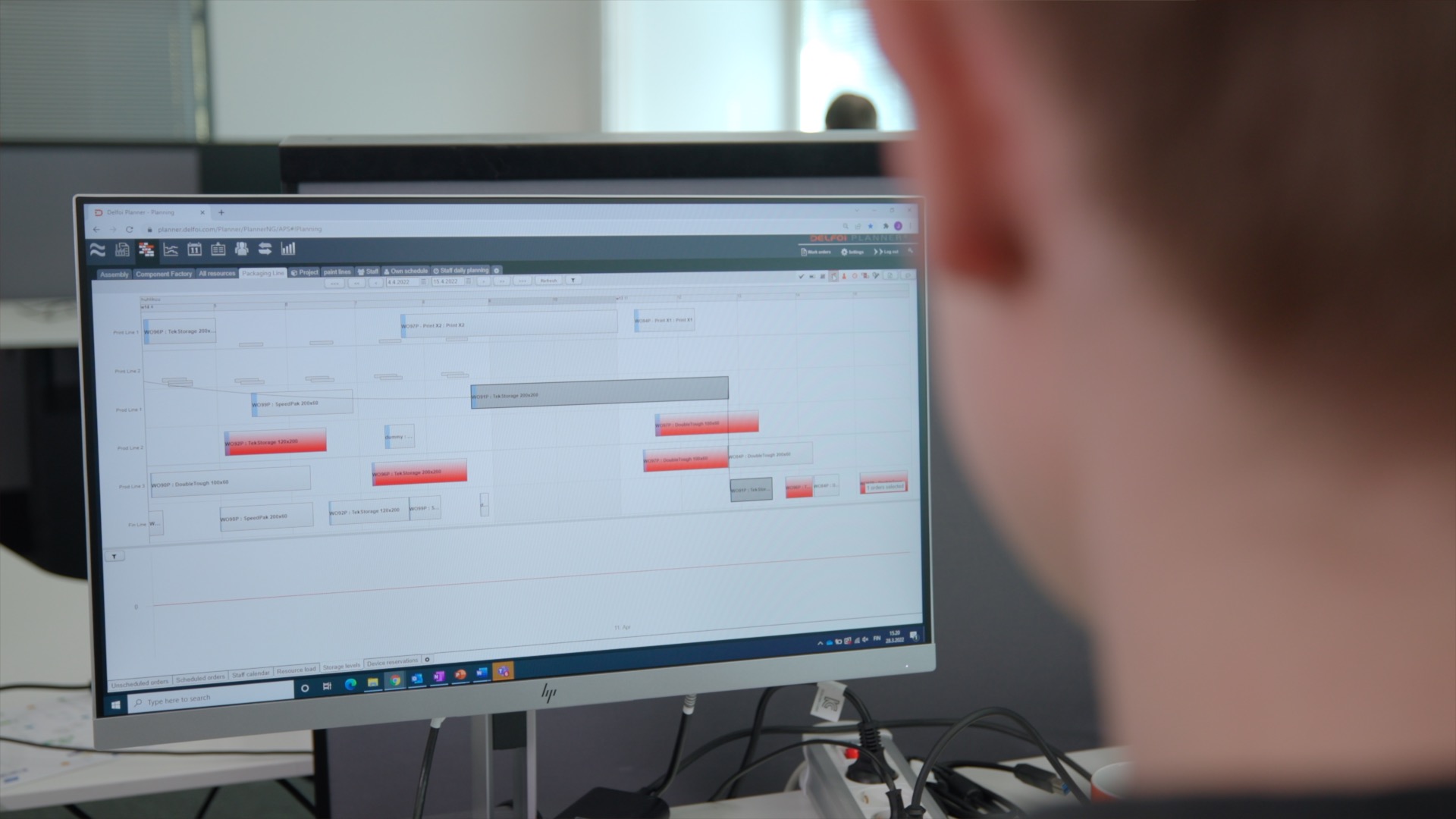
ERP users experience transformative operational improvements when implementing Delfoi Planner alongside their enterprise systems. The most immediate benefit is enhanced production visibility that extends far beyond what traditional ERP systems can provide alone. While ERP excels at transaction processing and business-level planning, Delfoi Planner brings sophisticated scheduling capabilities that visualize production down to individual operations and resources.
Real-time capacity planning becomes possible with accurate, dynamic resource modelling. ERP users gain the ability to perform what-if scenarios against actual shop floor constraints, not just high-level capacity buckets. This means production planners can immediately see the ripple effects of schedule changes, new orders, or resource unavailability—before committing changes to production.
Scheduling accuracy improves dramatically through Delfoi Planner’s intelligent algorithms that consider multiple constraints simultaneously. While ERP systems typically schedule based on standard lead times or simple capacity checks, our solution accounts for complex dependencies including machine capabilities, tooling requirements, personnel skills, and material availability. The result is a production schedule that reflects operational reality, with delivery promises that can be kept.
Manual data entry decreases substantially, as information flows automatically between systems. Production planners escape the spreadsheet trap, eliminating hours spent transferring data between systems or creating workarounds for ERP limitations. In typical implementations, planning departments reduce administrative workload by 30-50%, allowing focus on value-adding activities instead of data management.
These benefits translate directly to measurable business outcomes:
- On-time delivery improvements of 15-25%
- Production lead time reductions of 10-30%
- Work-in-process inventory reductions of 15-20%
- Resource utilization improvements of 10-15%
- Planning cycle time reductions of 50-70%
For ERP users, these improvements represent the difference between managing transactions and truly optimizing production operations. While the ERP remains the system of record, Delfoi Planner becomes the system of action for manufacturing excellence.
How long does it take to integrate Delfoi Planner with an existing ERP?
Integration timelines between Delfoi Planner and existing ERP systems vary based on several factors, but most implementations follow a predictable path. For standard integrations with major ERP platforms, customers typically achieve operational status within 2-3 months from project initiation to production use.
Several factors can influence these timelines:
- ERP customization level – highly customized ERP implementations may require additional interface development
- Data quality – cleansing or normalizing problematic data may extend the configuration phase
- Organizational readiness – availability of key stakeholders and IT resources affects project momentum
- Integration scope – phased approaches with limited initial scope can accelerate initial deployment
- Testing thoroughness – more extensive testing scenarios increase confidence but extend timelines
Maximizing your production control investment: Strategic implementation of Delfoi Planner
Realizing optimal returns from your production control investment requires more than technical implementation—it demands strategic alignment with business objectives and processes. Successfully implementing Delfoi Planner involves several key considerations that dramatically influence both short-term results and long-term value creation.
Begin with clear identification of pain points and objectives. Organizations achieving the highest ROI start by documenting specific challenges in their current production planning process—whether excessive lead times, poor resource utilization, or delivery reliability issues. These specific targets create measurable benchmarks to track improvement and justify investment.
Our standard integration approach enable fast implementations with robust and tested interfaces with major ERP systems.
Consider a phased implementation approach that delivers incremental benefits rather than attempting comprehensive transformation. Begin with core scheduling functionality for critical production areas, then expand to advanced features like what-if scenario planning or detailed material requirements planning once basic processes are stable.
User adoption represents perhaps the most crucial success factor in production control implementations. Beyond technical training, focus on helping planners understand how the system improves their decision-making capabilities. Create internal champions who can demonstrate practical benefits to colleagues and provide peer support during the transition period.
Future-proofing your investment requires ongoing optimization and evolution. Production environments constantly change with new products, processes, and business requirements. The most successful organizations establish regular review cycles to evaluate system performance, identify improvement opportunities, and align production control capabilities with evolving strategic priorities.
By approaching Delfoi Planner implementation as a strategic business initiative rather than merely a technical project, manufacturers establish the foundation for continuous improvement in production performance. The resulting competitive advantages—from faster delivery times to improved resource utilization—provide sustainable differentiation in increasingly challenging markets.